
St. Mary's County Property Tax Records
St. Mary's County property tax records are maintained by the Maryland State Department of Assessments and Taxation and are open to the public. You can search assessment data, tax bills, and ownership history for any parcel in St. Mary's County using the SDAT Real Property Data Search. This southern Maryland county uses county code 19 in the state system. Records go back many years and cover all types of property in the area.
St. Mary's County Overview
SDAT Search for St. Mary's County
The Maryland State Department of Assessments and Taxation runs the primary database for St. Mary's County property tax records. The SDAT Real Property Data Search at sdat.dat.maryland.gov lets you look up any parcel in St. Mary's County for free. Select "St. Mary's County" from the county dropdown, which maps to county code 19 in the system. From there you can search by owner name, street address, or parcel account number.
Each result in the SDAT database shows the current assessed value, the owner of record, the property address, and the land use classification. You will also see the assessment history going back several cycles. This is useful if you want to track how a property's taxable value has changed over time in St. Mary's County. The site also shows whether a Homestead Tax Credit is in place for any given property. Results load fast and no login is needed.
The SDAT office can be reached directly at 410-767-1184 or through the contact page at dat.maryland.gov. The main SDAT site at dat.maryland.gov has additional resources including appeal forms and credit applications. If you need help with a search or want to confirm property details in St. Mary's County, SDAT staff can assist you by phone or in writing.
The SDAT Real Property Data Search is the first stop for anyone looking up property tax records in St. Mary's County. The tool is free and available at all hours.
The screenshot below shows the SDAT Real Property Data Search interface for St. Mary's County property tax lookups.
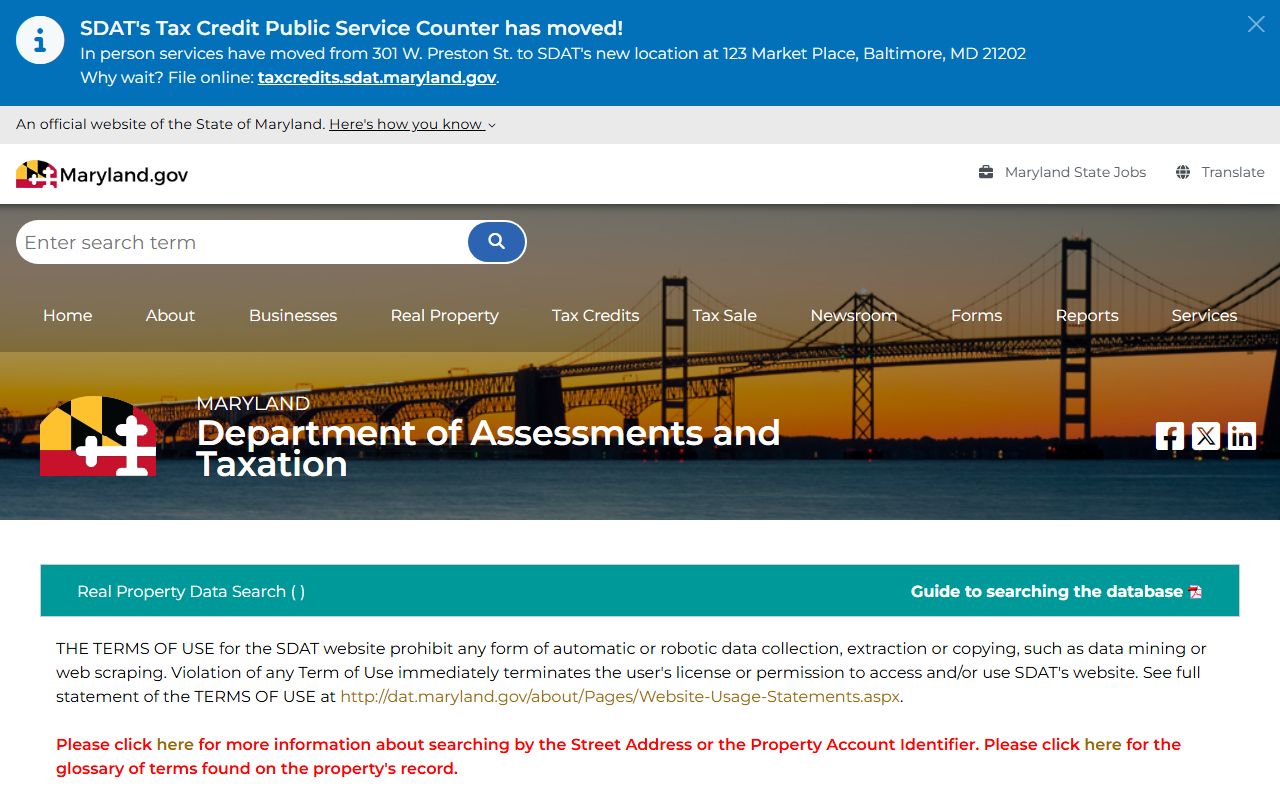
Use county code 19 when prompted to narrow your search to St. Mary's County specifically.
St. Mary's County Government Resources
The St. Mary's County Government website at stmaryscountymd.gov is a key source for local tax information. The site covers county tax rates, payment options, and links to related departments. County staff can answer questions about property tax bills, credits, and local charges that apply in St. Mary's County specifically.
St. Mary's County also operates a 311 service for residents who need help with county services and inquiries. If you have a question about a property tax notice, a billing concern, or want to know the status of a local charge, the 311 line connects you to the right department. This service is a practical option for homeowners in St. Mary's County who are not sure where to start when dealing with a tax or billing issue. The county government site also lists office hours and contact details for specific departments.
The screenshot below shows the St. Mary's County Government website where you can find tax-related resources and department contacts.
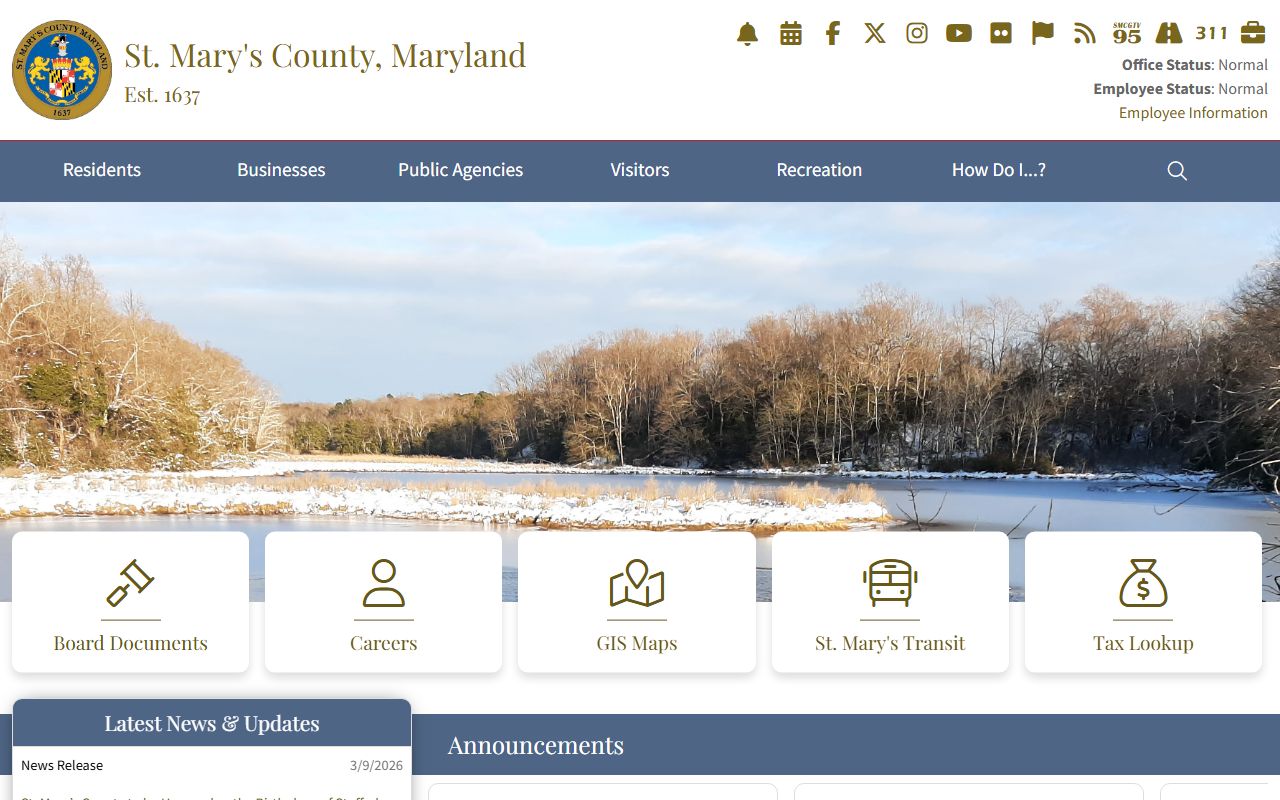
The county site at stmaryscountymd.gov is updated regularly and reflects current local tax rates and procedures for St. Mary's County.
For current property tax rates in St. Mary's County, the Maryland Department of Budget and Management publishes a full rate table at dbm.maryland.gov. This table covers both county and municipal rates and is updated each year.
Note: If you cannot reach the 311 line, the county government website has an online request form you can use to submit questions about property taxes in St. Mary's County.Municipal Tax Clearance in St. Mary's County
St. Mary's County has a specific rule that applies when property changes hands. Under Real Property Article § 3-104, both outstanding municipal charges and any unpaid county taxes must be paid before a deed can be recorded. This requirement affects all property transfers in St. Mary's County. A buyer and seller cannot complete a real estate transaction until the land records clerk confirms that all charges have been cleared.
This rule matters most when a property has an unpaid water bill, utility lien, or other local charge attached to it in St. Mary's County. Unlike some counties where only state or county taxes block a transfer, St. Mary's County requires clearance of municipal charges as well. Title companies and settlement attorneys working in St. Mary's County routinely check for these charges before closing. Failing to clear them will delay recording of the deed.
If you are buying or selling property in St. Mary's County, ask your settlement attorney to verify both county tax balances and any outstanding municipal charges early in the process. This step prevents delays at the land records office. The requirement under Real Property Article § 3-104 is firm and applies to all property types in St. Mary's County.
Note: Clearing municipal charges before deed recording is a St. Mary's County-specific requirement that goes beyond the standard state tax lien rules and can catch buyers off guard at closing.Maryland Land Records for St. Mary's County
The Maryland Land Records system at mdlandrec.net provides access to deeds, mortgages, and liens filed in St. Mary's County. These documents are part of the property record and often contain information that ties directly to tax obligations. A deed shows who holds title. A mortgage shows what debt is secured by the property. A lien shows what charges are unpaid. All of these affect the tax and ownership picture for any parcel in St. Mary's County.
When you search land records for St. Mary's County on mdlandrec.net, you can look up documents by grantor, grantee, or document type. The system covers recorded documents going back many years. Basic searches are free. Certified copies carry a fee set under Real Property Article § 3-602 at $5 per copy. Standard recording fees in St. Mary's County follow Real Property Article § 3-601: a release costs $10, a document of nine pages or fewer costs $20, and a document of ten or more pages costs $75.
Lenders also have obligations tied to land records in St. Mary's County. Under Real Property Article § 7-107, a lender must record a release within 45 days of a loan payoff. If a release is missing from the land records for your St. Mary's County property, this statute gives you a basis to request that the lender act. The Maryland State Archives at msa.maryland.gov holds historical land records that predate the digital system for St. Mary's County.
St. Mary's County Property Assessment Process
SDAT reassesses all property in St. Mary's County on a three-year cycle as required by Tax-Property Article § 2-203. This means your property in St. Mary's County is formally revalued once every three years. Between cycles, the assessed value stays the same unless there is a major change to the property, such as new construction or a structural alteration. The reassessment notice arrives by mail and shows the new value along with the phase-in schedule.
Assessors in St. Mary's County use three standard methods to determine value. The sales comparison approach looks at what similar properties have sold for recently. The cost approach estimates what it would cost to rebuild the structure today, adjusted for depreciation. The income approach applies to rental or commercial property and looks at what income the property generates. Residential property in St. Mary's County typically relies on the sales comparison method. The assessor may use more than one method and weigh them based on available data.
Under Tax-Property Article § 8-401, increases in assessed value are phased in over three years in Maryland, including St. Mary's County. This means that even if your property jumps in value at reassessment, the full increase does not hit your tax bill at once. Each year, one-third of the increase is added to your taxable base. This phase-in softens the impact of large valuation swings on St. Mary's County property owners.
The Maryland Open Data Portal at opendata.maryland.gov publishes statewide assessment and property data that includes St. Mary's County. This can be useful for reviewing trends in local property values over time.
St. Mary's County Tax Credits and Exemptions
Several tax credit programs can lower the property tax burden for eligible owners in St. Mary's County. The Homestead Tax Credit is available to all owner-occupied primary residences. It caps the increase in taxable assessment at 10% per year for state purposes, and counties set their own cap. To get this credit in St. Mary's County, you must apply once with SDAT. The credit stays in place as long as the property remains your primary home. You can apply through the SDAT site at dat.maryland.gov.
The Homeowners' Tax Credit is an income-based program. It limits how much of your income must go toward your property tax bill in St. Mary's County. Eligible homeowners receive a credit that offsets the amount owed above a set threshold based on household income and property tax. You apply each year through SDAT, and the credit is applied to your tax bill. This program helps lower-income homeowners in St. Mary's County who own their home but face high tax bills relative to their earnings.
Disabled veterans who own property in St. Mary's County may qualify for a full exemption from property taxes. The exemption applies to the primary residence of a veteran with a 100% service-connected disability rating. Surviving spouses of qualifying veterans may also be eligible. This exemption is administered by SDAT and requires documentation of the disability rating. Applications are submitted to the local SDAT office serving St. Mary's County.
Historic property tax credits are available in some cases through the Maryland Historical Trust at mht.maryland.gov. If you own a historic structure in St. Mary's County, this program may reduce your tax liability in exchange for preserving the property's historic character.
The programs listed here are the main credits and exemptions that apply to property in St. Mary's County:
- Homestead Tax Credit (owner-occupied primary residence)
- Homeowners' Tax Credit (income-based, applied annually)
- Disabled Veterans Exemption (100% service-connected disability)
- Surviving Spouse Exemption (qualifying veteran's widow or widower)
- Maryland Historic Rehabilitation Tax Credit (historic structures)
St. Mary's County Property Tax Payment
Property tax bills in St. Mary's County are due annually. The full amount is due by September 30. A second installment option allows half to be paid by September 30 and the remaining half by December 31. Most homeowners in St. Mary's County choose one of these two paths. Check your bill for the exact amounts and due dates, as they can vary slightly based on your specific parcel and any credits applied.
If a property tax bill in St. Mary's County goes unpaid, interest begins to accrue at a rate of 1% to 1.5% per month depending on the type of charge. Unpaid taxes can eventually lead to a tax sale, where the county sells the tax lien to a third party to recover the debt. Once a tax sale occurs, the property owner in St. Mary's County must redeem the lien by paying the full amount plus penalties and interest or risk losing the property. The St. Mary's County Government website has details on the tax sale process and redemption options.
For questions about your specific tax bill, payment history, or outstanding balance, the St. Mary's County Government at stmaryscountymd.gov is the right contact. The Maryland General Assembly site at mgaleg.maryland.gov has the full text of the Tax-Property Article if you want to review the underlying law that governs property taxes in St. Mary's County.
Appealing a Property Tax Assessment in St. Mary's County
If you believe the assessed value of your St. Mary's County property is too high, you have the right to appeal. The first step is to file with the local Supervisor of Assessments office that covers St. Mary's County. You must do this within 45 days of receiving your reassessment notice. The supervisor will review your evidence and may adjust the value. Bring comparable sales, photos, or an appraisal to support your case.
If the supervisor's decision does not satisfy you, the next step is the Property Tax Assessment Appeal Board for St. Mary's County. This is the county-level board that hears formal appeals from property owners. From there, if you still disagree, you may appeal to the Maryland Tax Court at courts.state.md.us/mdtaxcourt. The Tax Court is an independent agency and handles statewide appeals from property owners and local governments alike. The appeal process in St. Mary's County follows the same statutory framework used across Maryland.
Keep records of all communications and deadlines during an appeal. Missing a filing window closes that round of appeal in St. Mary's County. The SDAT site at dat.maryland.gov has the forms and instructions you need to start the process.
Nearby Counties
St. Mary's County sits on a peninsula in southern Maryland. Two counties share its northern border. If a property straddles a county line or you are searching for records in a neighboring area, the pages below cover property tax records for those counties.