
Maryland Property Tax Records
Maryland property tax records are public documents managed by the State Department of Assessments and Taxation, known as SDAT. The agency oversees more than 2 million property accounts across all 23 counties and Baltimore City. You can search assessment data, owner names, parcel details, and tax maps for free using the SDAT Real Property Data Search. This guide covers how to find Maryland property tax records, what tools are available, how the assessment process works, and where to go if you need to pay a tax bill or challenge a valuation.
Maryland Property Tax Records Overview
SDAT Real Property Data Search
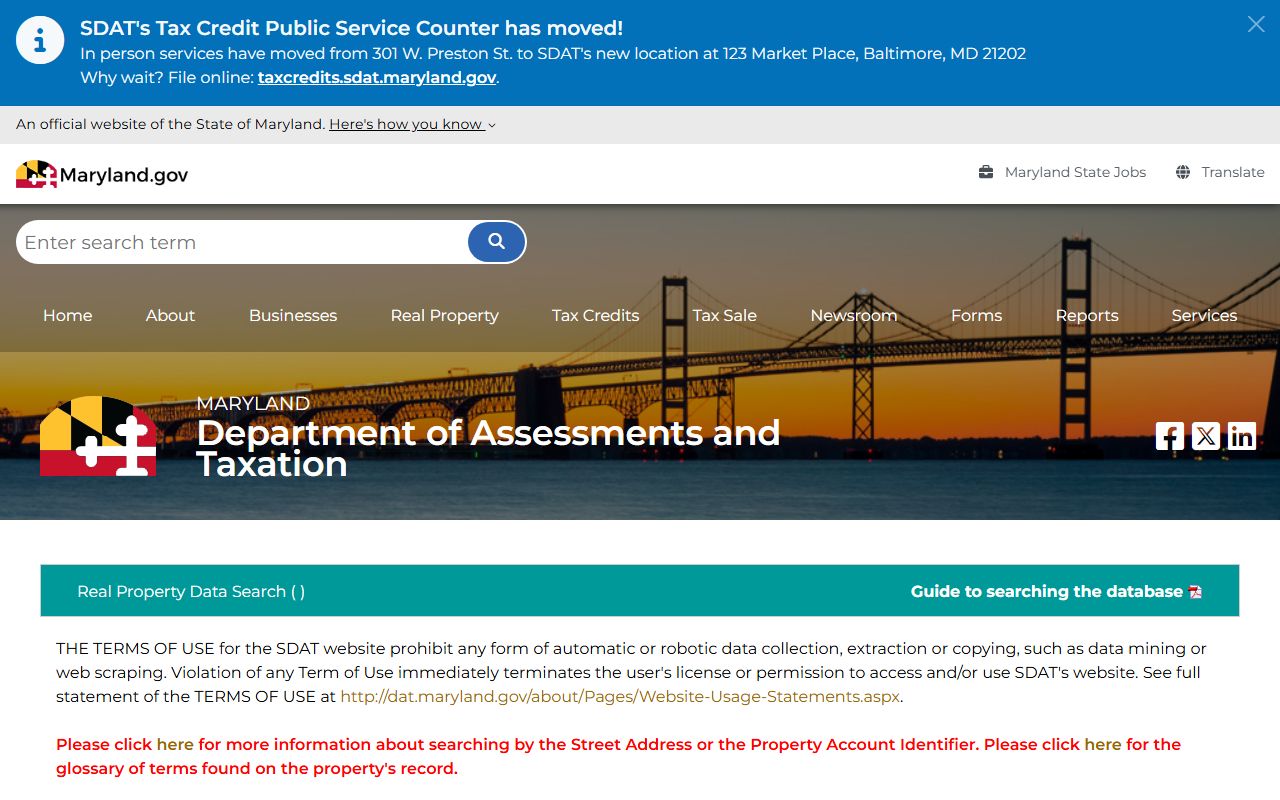
The main tool for searching Maryland property tax records is the SDAT Real Property Data Search at sdat.dat.maryland.gov. This free database covers all 24 jurisdictions in Maryland. No account is needed. The system is available 24 hours a day, except for a brief maintenance window before 7:00 AM. You can search by property address, owner name, account number, or map and parcel details. Results include the assessed value, owner name, legal description, and other key data for each property in Maryland.
A few tips help you get better results when using the SDAT search. Do not include street directions like N, S, E, or W. Skip suffixes such as Ave, St, or Blvd. If you leave off the street number, the search returns all properties on that street. You can use an asterisk as a wildcard. For example, searching "301 Pr*" returns matches for Preston, President, and Pratt. Leaving off the number entirely shows all properties on that street statewide in Maryland.
Maryland property account numbers follow a standard format: # CC DD AAAAAA XX. The CC stands for the two-digit county code, DD is the assessment district, and AAAAAA is the account number. Anne Arundel County uses a different format that adds a three-digit subdivision code. Baltimore City uses a Ward + Section + Block + Lot system unique to that jurisdiction. Every Maryland county has a code from 01 through 24. Knowing your code speeds up lookups in the SDAT database significantly. SDAT maintains an office in each of the 24 jurisdictions and can be reached at 410-767-1184 for general inquiries. You can also find local office contacts at dat.maryland.gov.
Note: SDAT never charges fees for searching assessment data, filing an appeal, or getting a copy of your property assessment worksheet in Maryland.
Maryland Land Records
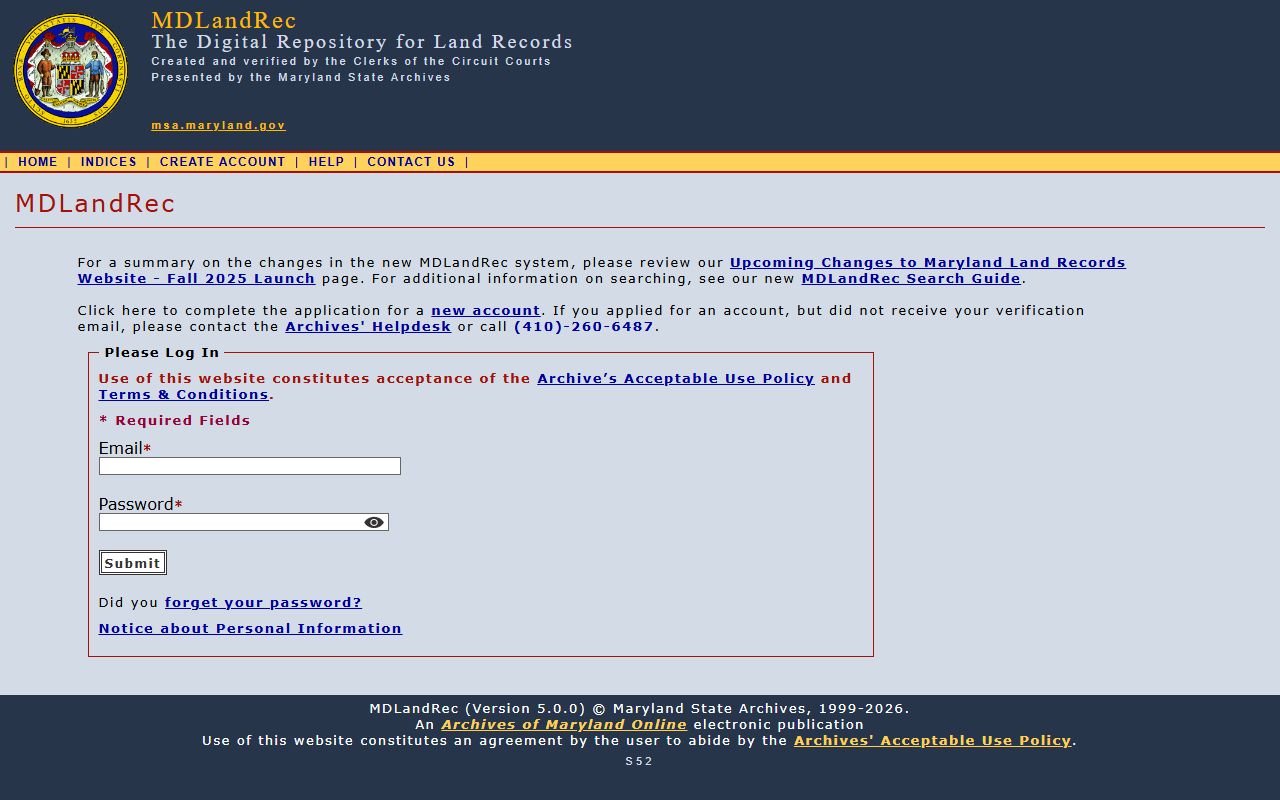
Maryland Land Records at mdlandrec.net is a second key tool for property research. This site is run by the Maryland State Archives and gives access to recorded documents including deeds, mortgages, and liens. Free registration is needed to view full documents. Once you sign up, you can search by grantor or grantee name, property address, or document reference number. You can download digital images of recorded papers. This is the right resource when you need deed history or want to trace who has owned a Maryland property over time. The helpdesk number is (410) 260-6487.
Under Maryland Real Property Article § 3-104, a deed must carry a tax collector's certificate before it can be recorded in Maryland. All public taxes and charges on the property must be paid before any transfer can occur. This rule applies statewide. In Cecil, Charles, Dorchester, Harford, Howard, Kent, Queen Anne's, Somerset, and St. Mary's counties, municipal corporation charges must also be cleared before a deed records. Certified copy fees for land documents are set at $5 per copy under Real Property Article § 3-602. Recording fees for other instruments vary under § 3-601, ranging from $10 for a short release to $75 for longer documents. The Maryland General Assembly updates these amounts, and current statutes are available at mgaleg.maryland.gov.
Tax Maps and GIS Property Tools
Maryland maintains over 2,800 tax maps covering the entire state. These maps show parcel boundaries and are compiled from deed descriptions and recorded plats. They are useful reference tools but are not legal property descriptions. SDAT publishes sample tax maps through its website so you can see how they are formatted. Plats are also available at local Land Records offices in each county and through opendata.maryland.gov. The Maryland Open Data Portal hosts statewide property datasets in GIS-compatible formats, including parcel boundaries and sales data, all free to download.
The Maryland Department of Planning offers MdProperty View, a desktop GIS product that links tax maps and parcel data directly to SDAT records. It includes over 250 map layers covering aerial photos, zoning, floodplains, census data, and watershed boundaries. FINDER Online is the web-based version at planning.maryland.gov. It lets you search by owner name, address, or account number and view or print parcel reports. FINDER links directly to the SDAT Real Property website for each parcel it shows.
The Maryland GIS Data Catalog at dev-maryland.opendata.arcgis.com provides even more layers and datasets tied to property data across the state.

How Maryland Property Assessments Work
Maryland law requires SDAT to review each property assessment at least once every three years. This is the triennial cycle set out in Tax-Property Article § 2-203. Properties are grouped by area, type, or use for the review period. SDAT assessors use three accepted approaches to estimate fair market value: the sales approach, the cost approach, and the income approach. The sales approach compares the property to similar ones that sold recently. The cost approach estimates what it would take to replace the improvements, then subtracts depreciation. The income approach applies mainly to commercial and rental properties where value depends on earnings potential.
SDAT sends a Notice of Assessment to property owners whenever a value changes. The notice shows the new figure and explains how to appeal. You can also ask for a copy of your assessment worksheet at any time at no charge. When a notice arrives, you have a limited window to respond if you think the number is wrong. Missing that window means waiting until the next triennial cycle. Physical inspections happen in specific cases: when improvements are new, when a recent sale requires a market check, or when a property owner requests an inspection as part of an appeal process in Maryland.
Tax-Property Article § 8-401 governs how assessors determine full cash value for real property in Maryland. The assessment is set to reflect what the property would sell for in an open-market transaction between a willing buyer and a willing seller. That assessed value is what local governments use to calculate your tax bill each year. The assessment and the tax rate are separate things. SDAT controls the assessment. Your county or city controls the rate. Both appear on your annual property tax bill in Maryland.
How to Appeal a Maryland Property Assessment
If your Maryland property tax assessment seems too high, you can appeal it at no cost. There are three levels to the appeal process. The first step is a review by the Supervisor of Assessments at your local SDAT office. File a Petition for Review form, which is available free on the SDAT website. If the result is not satisfactory, you can move to the second level: the Property Tax Assessment Appeal Board in your county. The third and final option is the Maryland Tax Court, which handles cases where a county board ruling is contested.
New property owners have a special option. You can file a New Owner Appeal form within 60 days of the deed transfer date. This lets you challenge the assessment on a property you just purchased in Maryland. SDAT cautions homeowners to ignore unsolicited mail offering to file appeals for a fee. Filing an appeal with SDAT is always free. All forms and instructions are on the SDAT website at dat.maryland.gov. Staff at local assessment offices can walk you through the steps as well.
Maryland Property Tax Laws
Property tax law in Maryland is found mainly in the Tax-Property Article of the Maryland Code. Under Tax-Property Article § 7-104, property tax is a primary revenue source for local governments in the state. Counties and municipalities depend on it to fund public services. SDAT sets assessed values statewide, while each local government sets its own rate. A separate state property tax is also levied and flows to the state budget. The Maryland Comptroller manages state tax matters and provides general information at marylandtaxes.gov. Current property tax rates by county are available through the Department of Budget and Management.
Real Property Article § 7-107 sets rules for mortgage lenders. When a property has a mortgage, the lender is often responsible for paying the tax bill from escrow. Under this statute, lenders must pay within 45 days of the first due date, receipt of the tax bill, or when escrow funds are sufficient, whichever comes last. If a lender pays late, it is liable for any penalties and interest that result. Property owners who pay taxes directly through escrow should confirm with their lender that taxes are being paid on time to avoid penalties on their Maryland property tax records.
Most Maryland counties set annual tax bills due on September 30. Semi-annual first installments are also due September 30, with second installments typically due December 31. Some counties extend this date. Delinquent taxes carry interest and penalties, usually 1 to 1.5 percent per month depending on the county. Continued non-payment can result in the county selling the tax lien at public auction. Maryland State Archives at msa.maryland.gov keeps historical land and tax records that go back to the colonial era and can help trace long-term ownership history of any parcel in the state.
Maryland Property Tax Credits and Exemptions
Maryland offers several programs that lower what homeowners and property owners pay each year. The Homestead Tax Credit limits how much your assessed value can increase annually for your principal residence. Once registered, the credit applies automatically and caps assessment growth at a set percentage. The Homeowners' Tax Credit is income-based and reduces the tax bill for qualifying low- and moderate-income owners. You apply for this program through SDAT each year by submitting an application before the deadline in Maryland.
Disabled veterans may qualify for an exemption on their primary home depending on the nature of the disability. Religious, charitable, and educational organizations are often exempt on property used directly for their mission under Maryland law. The Maryland Historical Trust at mht.maryland.gov also offers rehabilitation tax credits for qualifying historic properties. These credits reduce the final tax owed but do not change the assessed value shown in SDAT records. Contact your local SDAT office or visit dat.maryland.gov to find out which programs apply to your property in Maryland.
Paying Property Taxes in Maryland
Property taxes in Maryland are billed and collected at the county level, not by SDAT. Each county sets its own tax rate, due dates, and payment options. Howard County charges a county rate of $1.044 per $100 of assessed value, plus a state rate of $0.112. Washington County accepts online payments at washco-md.net with an ACH convenience fee capped at $1.95, or 3.3 percent for credit and debit card payments. Mail-in payments, in-person payments, and escrow through a mortgage company are also options in most Maryland counties.

If your taxes go unpaid, interest and penalties start adding up. Rates vary across Maryland but typically range from 1 to 1.5 percent per month. When delinquency continues long enough, the county may hold a tax sale and auction the lien to a third-party buyer. The original owner then has a limited redemption period to pay off the lien and keep the property. The process and timelines differ by county in Maryland. Reach out to your local county treasurer or finance office early if you have trouble paying. Some counties have payment plan options for qualifying property owners in Maryland.
Note: Some Maryland counties offer early payment discounts, typically 0.5 percent for payments made in July, and semi-annual payment options for owner-occupied homes.
Browse Maryland Property Tax Records by County
Each county in Maryland has its own SDAT assessment office and local tax collection system. Pick a county below to find resources, contact details, and search tools for that area.
Property Tax Records in Maryland Cities
Cities and communities across Maryland are served by county SDAT offices. Pick a city below to find property tax search resources specific to that area.