
Silver Spring Property Tax Records
Silver Spring property tax records are held and managed through Montgomery County and the Maryland State Department of Assessments and Taxation. Silver Spring is an unincorporated, census-designated place in the southeastern corner of Montgomery County, with no city government of its own. Every property tax function that applies to Silver Spring, from assessment to billing to appeals, runs through the county and state systems. This page covers the tools and offices you need to find and use Silver Spring property tax records, whether you are a homeowner, buyer, or researcher.
Silver Spring Quick Facts
How Montgomery County Handles Silver Spring Property Tax Records
Silver Spring is one of the most populous unincorporated areas in Maryland. Because it has no city charter and no independent government, there is no separate Silver Spring tax office and no Silver Spring municipal tax rate. All property tax functions fall to Montgomery County and the state. When you need to find Silver Spring property tax records, you are always working within the county and state systems. This is true for assessments, for billing, for tax credits, and for appeals.
The Montgomery County Government sets the local property tax rate each year as part of the county budget process. That rate applies to every taxable parcel in Silver Spring along with the state rate set by Maryland. Montgomery County also administers tax credits, handles delinquency, and runs the tax sale process for Silver Spring parcels. If your Silver Spring property tax bill looks wrong, or your assessment seems too high, the county is the right place to start. The SDAT office covering Silver Spring is the Montgomery County field office, reachable at 240-314-4510.
Every Silver Spring parcel has a unique account number in the state database. That number links the SDAT assessment record to the county tax bill and to the deed filed in Maryland Land Records. Knowing the account number speeds up any search. You can get it from a prior tax bill, from the SDAT portal, or from the MCAtlas GIS mapping tool on the Montgomery County website.
For a full breakdown of county-level offices, assessment procedures, and local resources available to all Montgomery County property owners including those in Silver Spring, visit the Montgomery County property tax records page. That page covers the SDAT field office in Rockville, the county Board of Appeals, payment options, and links to applicable programs.
Silver Spring sits entirely within Montgomery County. There is no overlap with any other county. All records, all offices, and all tax systems that apply to Silver Spring properties are Montgomery County systems.
Using SDAT to Search Silver Spring Property Tax Records
The Maryland State Department of Assessments and Taxation runs the main free database for looking up Silver Spring property tax records. The SDAT Real Property Data Search lets you find assessed values, owner information, parcel details, and assessment cycle data for any Silver Spring address. No login is needed. The tool is free to use at any time.
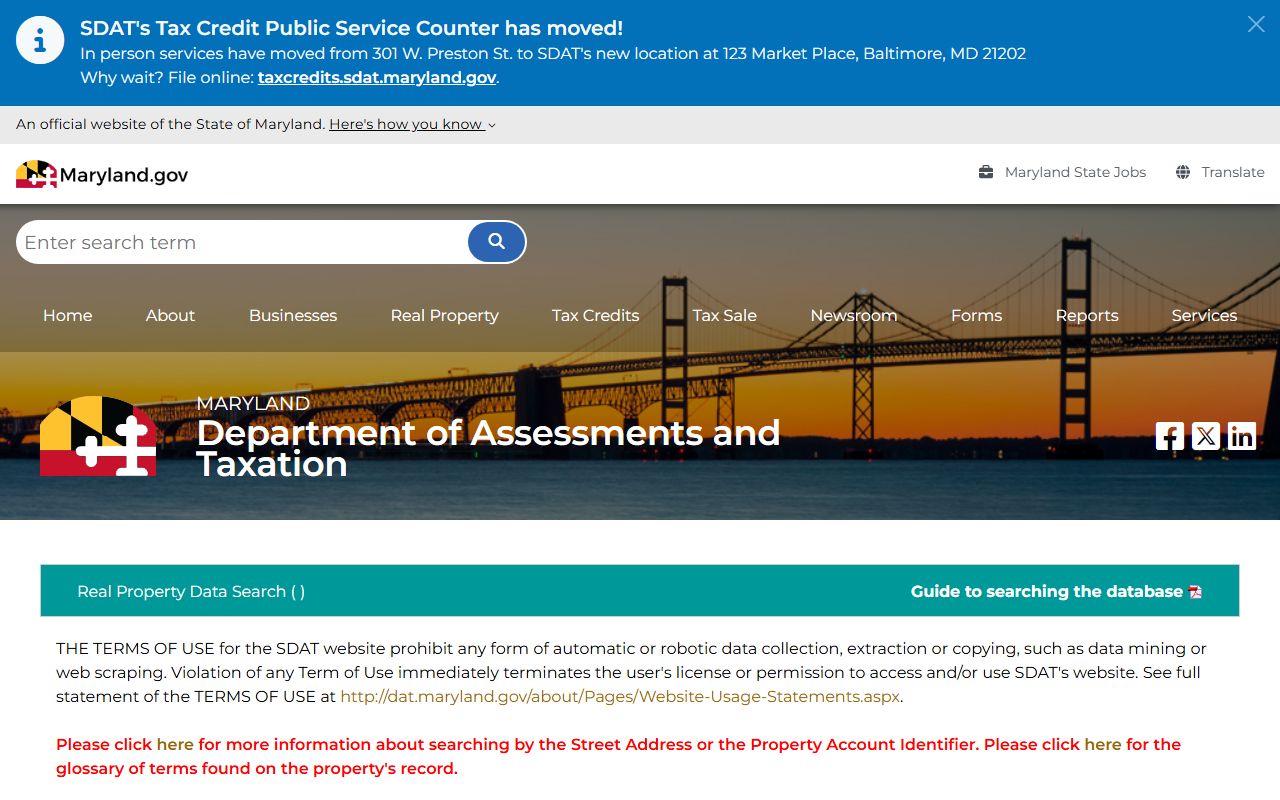
The portal at sdat.dat.maryland.gov/RealProperty is where most Silver Spring property tax record searches begin. Open the page and choose "Montgomery County" from the county list. The SDAT system uses county code 16 for all Montgomery County parcels, which covers every Silver Spring address. You can search by owner name, street address, or parcel account number. Address searches work best when you have a specific Silver Spring street address in hand. Name searches return all parcels held by a person or company in Montgomery County. Account number searches are the fastest and most precise if you already have the number from a prior bill or deed.
The screenshot below was captured from the SDAT real property search portal at sdat.dat.maryland.gov, showing the county selection screen where Silver Spring records are found by selecting Montgomery County.
After selecting Montgomery County, the results page for any Silver Spring parcel shows the property owner of record, mailing address, legal description, land use code, current assessed value, and the prior assessed value from the last triennial cycle. Maryland reassesses real property on a three-year rotating cycle under Tax-Property Article § 2-203. Not every Silver Spring property gets reassessed in the same year. The SDAT record shows when your property last went through the cycle and what the values were at that time. Increases in assessed value are phased in over the three years that follow the reassessment, so the taxable value can rise each year even without a new formal assessment.
If you have questions about a specific Silver Spring parcel record, call the Montgomery County SDAT office at 240-314-4510 or visit the SDAT main site at dat.maryland.gov to find additional contacts and resources.
Write down the parcel account number from any Silver Spring SDAT record you look up. That number stays tied to the property across ownership changes and makes any future search much faster.
Silver Spring Property Assessment Process
All Silver Spring properties fall under Maryland's triennial reassessment cycle. The state splits properties into three groups and works through one group per year, so each Silver Spring parcel gets a full reassessment every three years. When your property's turn comes, an SDAT assessor reviews it using one or more of three valuation methods.
The sales comparison approach is the most common method for Silver Spring residential parcels. The assessor looks at recent arm's length sales of comparable homes in the Silver Spring area and adjusts for differences in size, age, condition, and features. Silver Spring has a wide range of housing types, from high-rise apartments near the downtown corridor to quieter single-family blocks a few miles out. The assessor picks the homes that best match the subject property for the comparison. This method relies on actual recorded sale data, so a surge in Silver Spring home prices can push assessed values up when the next cycle comes around.
The cost approach estimates what it would cost to rebuild the structure today, then subtracts depreciation based on age and condition. This approach is more common for newer properties or for those where there are few comparable sales. The income approach is used for commercial and rental properties in Silver Spring and looks at what the property could earn in rent as the main driver of value. A mixed-use building near the Silver Spring transit center would likely be valued using the income approach, while a row house a few blocks away would use sales comparison. SDAT uses the method that best fits the type of parcel being assessed.
Once a new assessed value is set, Maryland phases in any increase over the next three assessment years. A decrease takes effect right away. So if your Silver Spring home was assessed at $300,000 and the new value is $360,000, the $60,000 increase phases in gradually over three years rather than all at once. This phase-in rule is built into the SDAT record and affects how your annual Silver Spring tax bill changes year to year.
Under Tax-Property Article § 8-401, Silver Spring property owners have the right to challenge their assessed value. The first step is requesting an Informal Hearing with the Supervisor of Assessments at the Montgomery County SDAT office. Call 240-314-4510 to set one up. If the result is not satisfactory, you can appeal to the Property Tax Assessment Appeals Board for Montgomery County. A further appeal can go to the Maryland Tax Court. Each step has its own deadline, so act quickly after receiving your Silver Spring assessment notice to keep your appeal rights open.
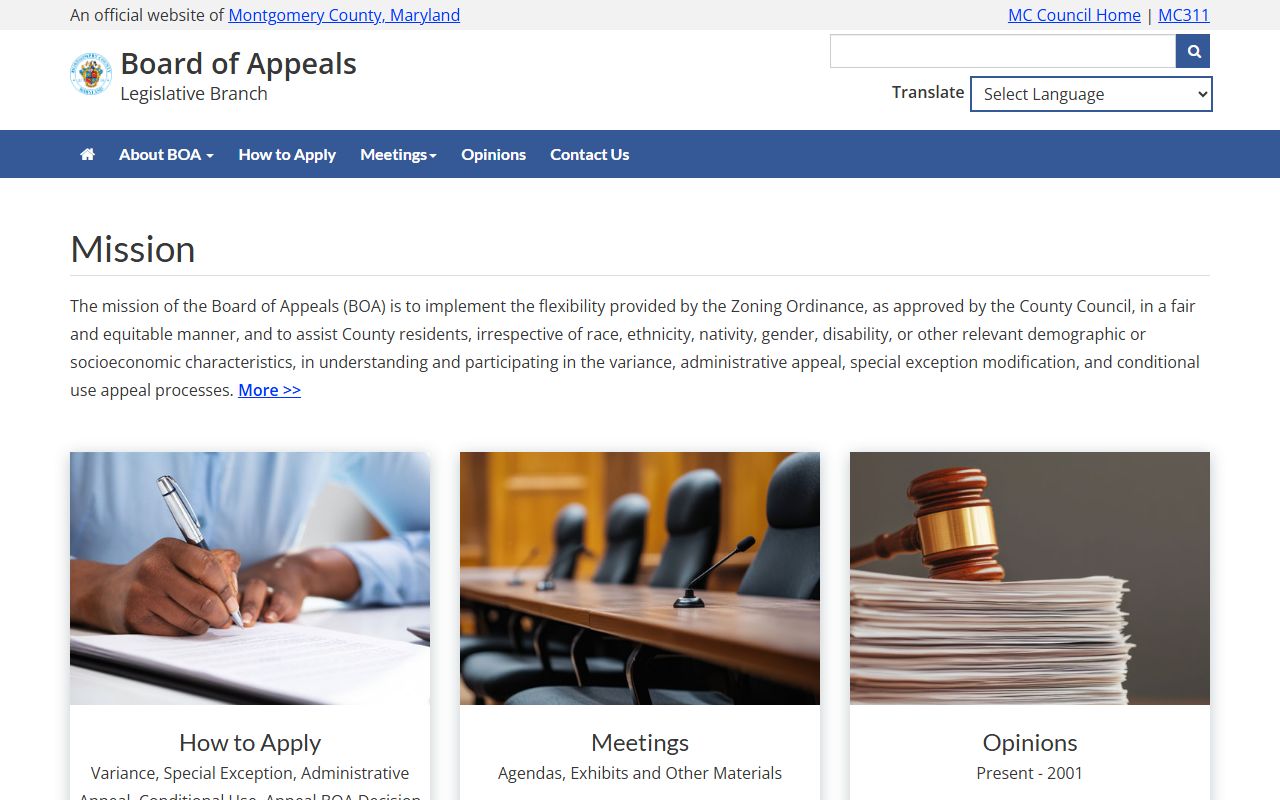
The Montgomery County Board of Appeals, accessible at montgomerycountymd.gov/BOA, handles formal appeals after the Informal Hearing stage. The BOA is the second tier in the Silver Spring property tax appeal process before a case moves to the Maryland Tax Court.
Tax Credits Available for Silver Spring Property Owners
Several programs can reduce property tax bills for Silver Spring homeowners who qualify. Some require a one-time application. Others need annual renewal. Missing a deadline can cost you a full year of savings, so it helps to know what is available and when to apply each spring.
The Homestead Tax Credit is one of the most valuable programs for Silver Spring owners who use their property as a primary residence. Once approved, the credit limits how much the taxable assessed value can rise each year, even if the full SDAT-assessed value climbs faster. You apply once through SDAT at dat.maryland.gov, and the credit stays in place as long as you own and live in the Silver Spring property. Many long-term Silver Spring homeowners who have seen market values rise sharply over the years benefit from this cap. The credit does not apply to rental properties or second homes, only to owner-occupied primary residences in Silver Spring.
The Homeowners' Tax Credit is a separate, income-based state program. It limits the share of income a Silver Spring homeowner pays in property taxes. Applications go through SDAT and must be filed each year. The program is open to all qualifying homeowners regardless of age, so younger Silver Spring residents who meet the income thresholds can apply. The credit amount is based on the property's assessed value and the applicant's gross income from the prior year.
Montgomery County adds its own local credits on top of state programs. The county runs a Senior Tax Credit program for older Silver Spring residents and a Supplemental Homeowners' Tax Credit for lower-income owners. Both are administered through the Montgomery County Government. Eligibility rules and filing deadlines for these local programs can change year to year, so check the county website each spring before the application window closes for Silver Spring properties.
Other programs that may apply to Silver Spring property owners include the Disabled Veterans' Exemption, which can remove part or all of the assessed value for eligible veterans with a service-connected disability rating, and agricultural land credits for any qualifying parcels. Call the Montgomery County SDAT office at 240-314-4510 to confirm which credits are active for a specific Silver Spring parcel and what documentation is needed to apply.
Maryland Land Records for Silver Spring Properties
Property tax records and land records are closely tied in Maryland. When you need to trace ownership, check for liens, or review title history before buying a Silver Spring property, land records are the place to look. Maryland Land Records at mdlandrec.net holds deeds, mortgages, releases, judgment liens, and other recorded instruments for all Montgomery County parcels including those in Silver Spring.
Under Real Property Article § 3-104, all outstanding property taxes on a Silver Spring parcel must be paid before a new deed can be recorded. That rule ties tax records and land records together on every sale in Maryland. If a deed for a Silver Spring property appears in the land records database, taxes were current at the time of transfer. You can cross-reference a recorded deed with the SDAT record to check the ownership and tax status at any given point. The parcel account number connects both systems. Searching by that number at mdlandrec.net pulls up all recorded documents tied to a specific Silver Spring address.
The screenshot below shows the Montgomery County Board of Appeals portal, which is part of the records ecosystem Silver Spring property owners use when challenging their assessments. The portal at montgomerycountymd.gov/BOA is the second formal step in the Silver Spring assessment appeal process.
Maryland Land Records also shows judgment liens filed against Silver Spring property owners. A judgment lien attaches to all real property the debtor owns in Maryland. If a Silver Spring property carries an undisclosed judgment lien, it shows up in mdlandrec.net as a recorded document tied to the parcel. Buyers and lenders routinely check for these during due diligence before a Silver Spring sale closes. A lien must be paid or released before the property can transfer with clear title.
Lenders holding mortgages on Silver Spring properties are required by Real Property Article § 7-107 to file a release of lien within 45 days of payoff. If you paid off a Silver Spring mortgage and the release has not appeared in the land records after 45 days, you can follow up with the lender directly or check the mdlandrec.net filing date. Missing releases should be tracked down early, since they can delay future sales. Standard recording fees in Maryland run $20 for documents up to nine pages under Real Property Article § 3-601.
Some older Silver Spring land records at mdlandrec.net may show only a document summary. Full copies of older Montgomery County documents may need to be obtained in person at the Circuit Court land records office in Rockville.
Silver Spring Property Tax Payment and Delinquency
Montgomery County sends annual property tax bills for Silver Spring parcels with a first installment due by September 30. A second installment option with a December 31 due date is available for owners who split their payment. Most Silver Spring homeowners with mortgage escrow accounts have taxes paid by their lender before these deadlines. If you pay directly outside of escrow, mark both dates to avoid interest charges.
Payments can be made online through the Montgomery County payment portal, by mail to the county tax office, or in person. Current tax rates for Silver Spring properties are published by the Maryland Department of Budget and Management at dbm.maryland.gov. That page lists the state rate and the Montgomery County rate that combine to form the total Silver Spring property tax rate. Rates are updated each year when the state and county budgets are finalized, so check the current figures before estimating what a specific Silver Spring parcel will owe.
If a Silver Spring property tax bill goes unpaid past the due date, interest begins to build. Montgomery County charges between 1 and 1.5 percent per month on delinquent balances. On higher-value Silver Spring parcels, that interest can grow to a significant amount over several months. Sustained non-payment can lead to a tax sale, in which the county offers the right to collect the delinquency to third-party buyers. A tax sale purchaser can eventually pursue foreclosure of the right of redemption if the Silver Spring owner does not pay off the lien plus accrued interest and costs.
Silver Spring property owners facing delinquency should contact Montgomery County as early as possible. Payment plan options may be available in some cases. Details on the tax sale process, redemption rights, and payment options are on the Montgomery County Government website. If there is a dispute about the Silver Spring assessment underlying the bill, the appeal process is the right path to challenge it before the next due date arrives.
The Maryland General Assembly website is the place to read the full text of the tax-property statutes that govern Silver Spring property tax procedures, including assessment cycles, appeal rights, and tax sale rules for all Maryland counties.
Montgomery County Property Tax Records
Silver Spring sits fully within Montgomery County. Every Silver Spring property tax record, assessment, appeal, and payment runs through the county system. The county page covers the SDAT field office, the Board of Appeals, county-level credits, payment options, and contacts for every community in Montgomery County including Silver Spring.
Nearby Cities in Montgomery County
These nearby communities are also in Montgomery County and use the same SDAT county code 16 and Montgomery County offices for property tax records. Each has its own page with local details.