
Bethesda Property Tax Records
Bethesda property tax records are managed by Montgomery County and the Maryland State Department of Assessments and Taxation, known as SDAT. Bethesda is an unincorporated community with no city government of its own, so all property tax functions fall to the county level. Whether you need to look up an assessed value, check what a property owner owes, or research a parcel before buying, this page explains the tools, offices, and resources that handle Bethesda property tax records.
Bethesda Overview
How Montgomery County Manages Bethesda Property Tax Records
Bethesda has no city hall and no local tax office. It is a census-designated place, which means it shows up on maps and in mailing addresses but has no governing body of its own. All property tax work for Bethesda runs through Montgomery County. The county bills property owners, collects taxes, and administers programs like the Homestead Tax Credit. If you have a question about a Bethesda property tax bill, the answer almost always starts with Montgomery County.
Montgomery County's Department of Finance handles the billing side. Once SDAT sets assessed values for Bethesda properties, the county applies its tax rate to calculate what each owner owes. Montgomery County sends annual tax bills, accepts payments, and manages delinquent accounts. The county government's main website at montgomerycountymd.gov has an online tax payment portal, account lookup tools, and contact information for the finance office. You can pay a Bethesda property tax bill online, by mail, or in person at the county offices in Rockville.
Because Bethesda sits right on the DC border and contains some of the highest-value residential real estate in Maryland, property tax records here can reflect assessments well above the state median. SDAT uses the same three-year cycle for Bethesda that it uses across all of Maryland, but the dollar figures involved are often large. Keeping track of your assessed value and knowing when your property is due for reassessment is worth the time for most Bethesda property owners.
One thing to keep in mind: Bethesda ZIP codes cover a wide area. Some properties with a Bethesda mailing address may technically fall in a slightly different part of Montgomery County. When you search SDAT or county records, always search by the property's exact street address rather than just the ZIP code to make sure you pull up the right parcel.
SDAT Database for Bethesda Property Records
The SDAT Real Property Data Search is the go-to tool for looking up any Bethesda property record online. SDAT is the state agency that assesses all real property in Maryland. For Bethesda, you select Montgomery County, which carries SDAT code 16, from the county dropdown. From there, you can search by street address, owner name, or account number. The portal returns the current assessed value, the owner of record, the property's legal description, and any active credits or exemptions.
The SDAT portal is free. No account is needed. You can search as many Bethesda properties as you want. Each result page shows both the land value and the improvement value separately, along with the total assessed value that the county uses to calculate the tax bill. For Bethesda properties, land values can be substantial on their own given how close the area is to Washington DC. The portal also shows prior assessment cycles, so you can see how values have shifted over the past three to six years.
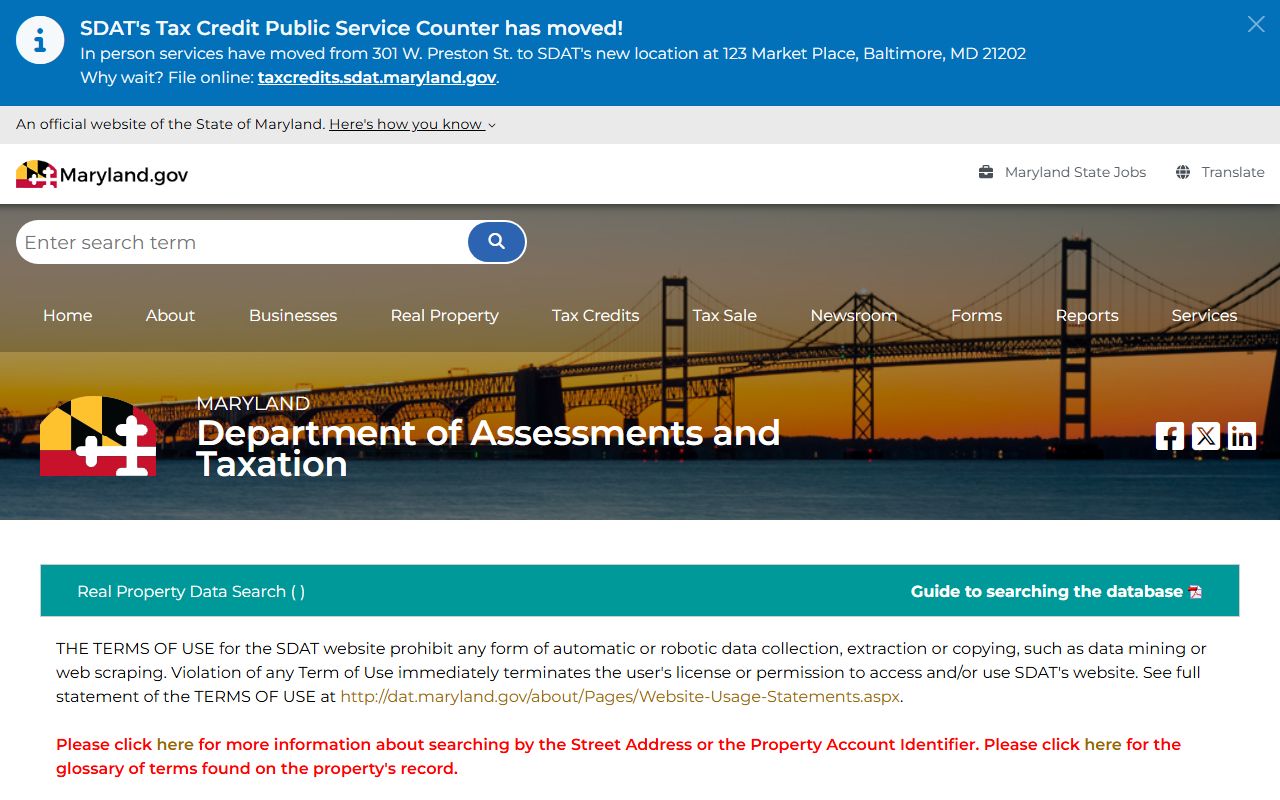
You can reach the SDAT Montgomery County office by phone at 240-314-4510 if you need to speak with someone about a Bethesda property assessment or a records question. The main SDAT website at dat.maryland.gov has office hours, mailing addresses, and forms for assessments, exemptions, and appeals. The direct link to the SDAT property search tool is at sdat.dat.maryland.gov. That portal handles all Bethesda and Montgomery County property lookups in one place.
When you pull up a Bethesda property record in the SDAT system, take note of the account number format. Montgomery County uses a standard Maryland account number format, which you can use in future searches to go straight to the parcel without typing the full address again.
High-Value Properties and Assessment in Bethesda
Bethesda is one of the most affluent communities in the country. Home prices routinely run well into the seven-figure range, and commercial properties along Wisconsin Avenue and Old Georgetown Road carry significant assessed values. That context matters when you are reviewing SDAT records for Bethesda properties. The numbers are large, but the process is the same as anywhere else in Maryland.
SDAT assesses Bethesda residential properties using the sales comparison approach as the primary method. Assessors look at recent sales of comparable homes in the surrounding area. Because Bethesda has an active real estate market with frequent sales, SDAT typically has solid comparable data to work with. For commercial and mixed-use properties in Bethesda, assessors also use income approaches based on rental rates and net operating income. If you own a commercial property and believe the income approach was applied incorrectly, that is often a strong basis for an appeal.
High assessed values in Bethesda can mean large tax bills even at Montgomery County's relatively competitive rate. That makes it worth checking your SDAT record each time your property is reassessed. Small errors in the property description, like a wrong square footage or an incorrect lot size, can push the assessed value above what it should be. Catching those errors early and filing an appeal is far easier than trying to recover overpaid taxes after the fact.
You can check current Maryland tax rates, including the Montgomery County rate, at the Department of Budget and Management site at dbm.maryland.gov. Rates are posted by county each year, so you can see both the state rate and the county rate that apply to your Bethesda property.
Assessment Cycle and Appeals Process
Maryland law under Tax-Property Art. § 2-203 requires SDAT to reassess all real property on a three-year cycle. Bethesda properties are split into three groups, and one group is reassessed each year. When your Bethesda property comes up for reassessment, SDAT mails a Notice of Assessment. That notice shows the new value and the prior value side by side.
Under Tax-Property Art. § 8-401, you have the right to appeal your assessment. The first level is an informal hearing with the SDAT Supervisor of Assessments in Montgomery County. You can request this hearing within 45 days of the date on your Notice of Assessment. The hearing is informal, free, and usually takes place by phone or in person at the local SDAT office. Bring any evidence you have, such as recent sales of comparable Bethesda homes, an independent appraisal, or documentation of property condition issues that SDAT may not have considered.
If you are not satisfied after the informal hearing, you can appeal to the Maryland Tax Court. The Maryland Tax Court handles formal appeals from property owners across the state. Their site at courts.state.md.us/mdtaxcourt has forms, filing instructions, and scheduling information. For high-value Bethesda properties where even a small percentage reduction in assessed value saves thousands of dollars annually, going through the full appeals process can be well worth it.
Montgomery County also has its own Board of Appeals for certain land use and assessment matters. You can find information about the Montgomery County Board of Appeals at montgomerycountymd.gov/BOA. Not all property tax disputes go through the Board of Appeals, but it is a resource worth knowing for Bethesda property owners dealing with county-level decisions.
Keep in mind that under Real Property Art. § 3-104, any unpaid tax charges on a Bethesda property must be resolved before a deed transfer can be recorded. If you are buying or selling, check the SDAT and county records carefully before closing to confirm no outstanding tax debt exists on the parcel.
Tax Credits for Bethesda Property Owners
Several tax credit programs can reduce the annual tax bill for Bethesda property owners. Some are statewide programs run through SDAT, and others are set by Montgomery County. Many of these credits require you to apply, so they do not kick in automatically when you buy a home.
The Homestead Tax Credit is the most widely used. It limits how much your taxable assessment can rise each year even if the market value of your Bethesda property climbs sharply. Once registered, the credit caps assessment increases for your principal residence. Montgomery County sets its own Homestead cap percentage under its local authority, and the state sets a separate statewide cap. Both apply to owner-occupied homes in Bethesda. You register once with SDAT, and the protection renews each year automatically as long as you continue to owner-occupy the property.
The Homeowners' Tax Credit is a state income-based program. If your Bethesda property taxes are high relative to your household income, the state may refund part of the difference. You apply through SDAT each year by September 1. The Maryland General Assembly sets the program rules, and you can find current statute language and application details at mgaleg.maryland.gov. Given the high property values in Bethesda, some property owners who would not qualify in other parts of Maryland may still qualify here if their income is modest relative to their assessed value.
Veterans and surviving spouses may qualify for property tax exemptions on their Bethesda home. The exemption amount depends on disability rating, and applications go through the SDAT Montgomery County office at 240-314-4510. Senior homeowners may also qualify for additional county credits on top of the state programs. Check the Montgomery County government website for the current list of local credit programs available to Bethesda property owners.
Credits worth knowing:
- Homestead Tax Credit (assessment cap for owner-occupants)
- Homeowners' Tax Credit (income-based state refund)
- Veterans and surviving spouse exemptions
- Senior tax credits set by Montgomery County
- Historic preservation credits for qualifying renovations
Maryland Land Records for Bethesda Properties
Property tax records tell you what a Bethesda parcel is assessed at and what taxes are owed. Land records tell you who owns it, what liens exist, and how the title has moved over the years. You need both to get the full picture on any Bethesda property. The main portal for Maryland land records is mdlandrec.net, run by the Maryland State Archives and the circuit courts.
For Bethesda properties, land records are filed with the Montgomery County Circuit Court Clerk. Deeds, mortgages, releases, and other instruments recorded against Bethesda properties are all searchable through mdlandrec.net. The site lets you search by name, address, or document type. Many records going back decades are digitized and available online at no charge. For older historical records, the Maryland State Archives may hold documents not yet in the online system.
The connection between land records and tax records is direct. Under Real Property Art. § 3-104, all tax charges on a Bethesda property must be paid and cleared before a deed can be recorded. That means if you are researching a Bethesda property and find a gap in the ownership chain, tax issues in the property's history may be part of the explanation. Checking both SDAT and the land records together gives you the most complete view of any parcel.

When you record a document against a Bethesda property in Montgomery County, fees apply based on document type and page count. Certified copies of recorded documents are available from the Montgomery County Circuit Court Clerk for a set fee per document. If you need a certified copy of a deed or mortgage for a Bethesda property, the land records portal at mdlandrec.net shows which documents are on file so you know what to request before you contact the clerk's office.
Using MCAtlas and GIS Tools for Bethesda Property Research
MCAtlas is Montgomery County's online GIS mapping system. It gives you a visual way to look at Bethesda properties and pull up parcel-level data without going through the SDAT search portal. MCAtlas is particularly useful when you are trying to locate a property by map rather than by address, or when you want to see adjacent parcels and lot boundaries in context.
In MCAtlas, you can click on any parcel in Bethesda and see its basic information, including owner name, parcel ID, acreage, and links back to SDAT and county records. The map layers include zoning, flood zones, and tax districts, which makes it a good starting point for any detailed property research. MCAtlas is free to use and does not require a login. You can find it through the Montgomery County government website at montgomerycountymd.gov under the GIS and mapping section.
GIS data is especially valuable in Bethesda because the community contains a mix of single-family homes, townhomes, condominiums, and commercial parcels, often in close proximity. Lot boundaries in older Bethesda neighborhoods can be irregular, and some parcels have been subdivided or combined over the years. MCAtlas shows current parcel boundaries as recorded, which helps you confirm that the lot you are researching matches what the SDAT record describes.
For Bethesda properties in planned developments or mixed-use zones along major corridors, MCAtlas can also show you overlay districts and special tax areas that may affect the total tax liability. Some Bethesda parcels fall within special taxing districts that carry additional charges on top of the standard county rate. Knowing about those districts before you research a property helps you understand the full tax picture. Pair MCAtlas with SDAT and the county finance tools for the most complete research workflow.
All Bethesda property tax records are administered by Montgomery County. Visit the county page for full details on offices, procedures, and resources.
Montgomery County Property Tax RecordsNearby Cities
Bethesda is surrounded by other Montgomery County communities. These nearby cities and census-designated places all fall under the same county property tax system and use the same SDAT county code 16 for records searches.