
Montgomery County Property Tax Records
Montgomery County property tax records cover more than one million residents across one of Maryland's largest and most active real estate markets. Whether you want to check an assessed value, review a tax bill, or trace ownership history, the tools to search Montgomery County property tax records are available online through state and county systems. This guide walks you through the main sources, how each one works, and what you can find in each database.
Montgomery County Overview
SDAT Search for Montgomery County Property Tax Records
The Maryland State Department of Assessments and Taxation runs the main database for Montgomery County property tax records. SDAT assigns each county a code, and Montgomery County is code 16. You use that code when you search the real property portal. The system is free and open to anyone. No login is needed to look up basic assessment data for a property in Montgomery County.
To search, go to the SDAT Real Property Data Search and select "Montgomery" from the county dropdown menu or enter code 16 directly. From there, you can search by owner name, street address, or parcel account number. The results show the property owner of record, the assessed value, the tax class, the land use code, and the date the last assessment went into effect. SDAT updates this data regularly, so what you see reflects current records for Montgomery County.
The SDAT local office that handles Montgomery County is based in Rockville. Staff there can answer questions about your assessment or provide information on properties that border yours. That office can give you abutting and confronting owner data, which is useful for surveyors, attorneys, and neighbors who need to know who owns the land next to a parcel. You can reach the Montgomery County SDAT office by phone at 240-314-4510. The main SDAT line is also available at dat.maryland.gov, or you can call 410-767-1184 for general questions.
The SDAT search is the starting point for any property tax inquiry in Montgomery County. It gives you a full picture of how the state assessed a property and what value the county uses to calculate the tax bill. Under Tax-Property Article § 2-203, assessments in Maryland run on a three-year cycle. That means Montgomery County property owners see a new assessed value every three years, not every year.
The screenshot below shows the SDAT real property search portal where you can look up Montgomery County property tax records by owner name, address, or parcel number.
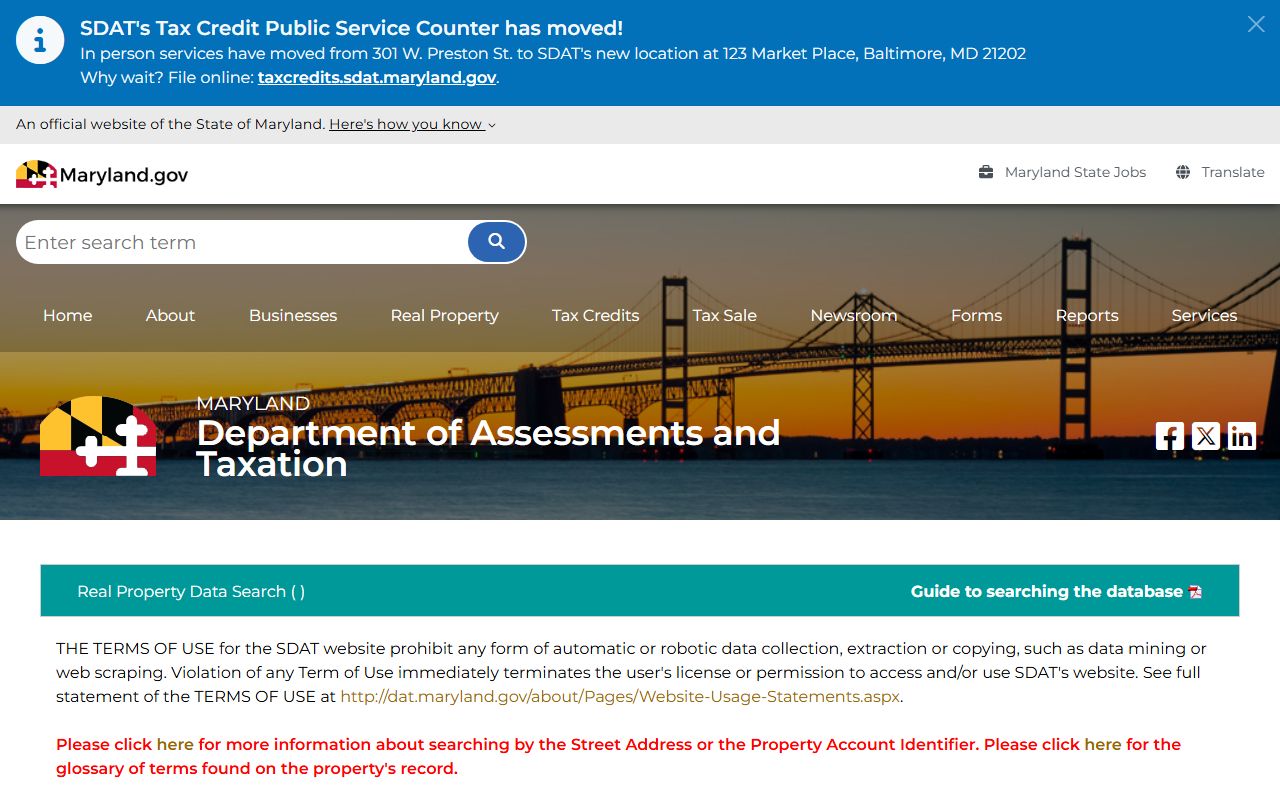
Once you run a search, the SDAT results page gives you a direct link to the full property detail sheet for any parcel in Montgomery County. That sheet breaks out the land value and the improvement value separately, which matters when you are comparing assessments or preparing an appeal.
Note: The SDAT portal works best on desktop browsers. Mobile users may need to scroll right to see all fields in the search results for Montgomery County properties.
Montgomery County Tax Payment and Online Portal
Montgomery County operates its own online portal at montgomerycountymd.gov. Through this site you can view your current property tax bill, check your payment history, and make payments online. The portal pulls data that is tied to the county's tax billing system. It works in tandem with SDAT assessments but is run by the county government, not the state.
Property tax bills in Montgomery County go out with a due date of September 30 for the full annual amount. If you pay in two installments, the second payment is due December 31. The county charges interest on late payments. That interest runs at 1 to 1.5 percent per month on any unpaid balance. Properties with continued nonpayment can go to tax sale, which is a formal legal process that allows the county to recover the owed taxes. Watching your bill online through the county portal is the easiest way to catch issues before they reach that stage.
The county portal also lists available tax credits and exemptions. Montgomery County has its own local credit programs on top of the state programs run through SDAT. Logging into the portal or calling the county treasury office can help you find out what credits your property may qualify for. Current tax rate schedules are also posted at the Maryland Department of Budget and Management tax rates page.
Note: Real Property Article § 3-104 requires that any outstanding taxes must be paid before a deed can be recorded in Maryland, which affects all property transfers in Montgomery County.
MCAtlas: Montgomery County GIS Mapping for Property Research
MCAtlas is Montgomery County's geographic information system. It gives you a map view of every parcel in the county. You can click on any parcel on the map and get basic ownership data, lot dimensions, zoning, and a direct link to the SDAT record for that property. MCAtlas is a good tool when you know a location but not the owner name or parcel number. It lets you search visually rather than by text fields.
The system is maintained by Montgomery County and is available free to the public. Real estate professionals, title companies, and researchers use MCAtlas to find properties, check boundaries, and verify parcel IDs before pulling a full SDAT or land records search. The map layers include aerial imagery, zoning boundaries, flood zones, and road data. For property tax research, the parcel layer is the most useful. It connects directly to the same county code 16 data that SDAT maintains, so the information is consistent across both systems.
MCAtlas also lets you download parcel data in some formats, which is useful if you need to work with property information across a neighborhood or development area. The Maryland Open Data Portal also has statewide datasets that include Montgomery County parcel and assessment data for bulk research purposes.
Montgomery County Board of Appeals
The Montgomery County Board of Appeals handles zoning appeals, variances, and special exceptions. While it is not a tax board, its decisions directly affect how a property may be used. A change in permitted use can affect the income a property generates, which in turn affects assessed value under the income approach that SDAT applies to commercial and rental properties. Property owners who are dealing with mixed-use parcels or who are changing a property's use should check Board of Appeals records as part of their broader research.
The Board also handles cases where a property owner disagrees with a zoning decision that limits how a parcel can be developed. If a restriction lowers the value of a property, that can be relevant in an assessment appeal. Knowing the Board's history on a parcel gives you context that goes beyond the raw SDAT numbers.
The screenshot below shows the Montgomery County Board of Appeals website where zoning decisions and appeal records are posted.
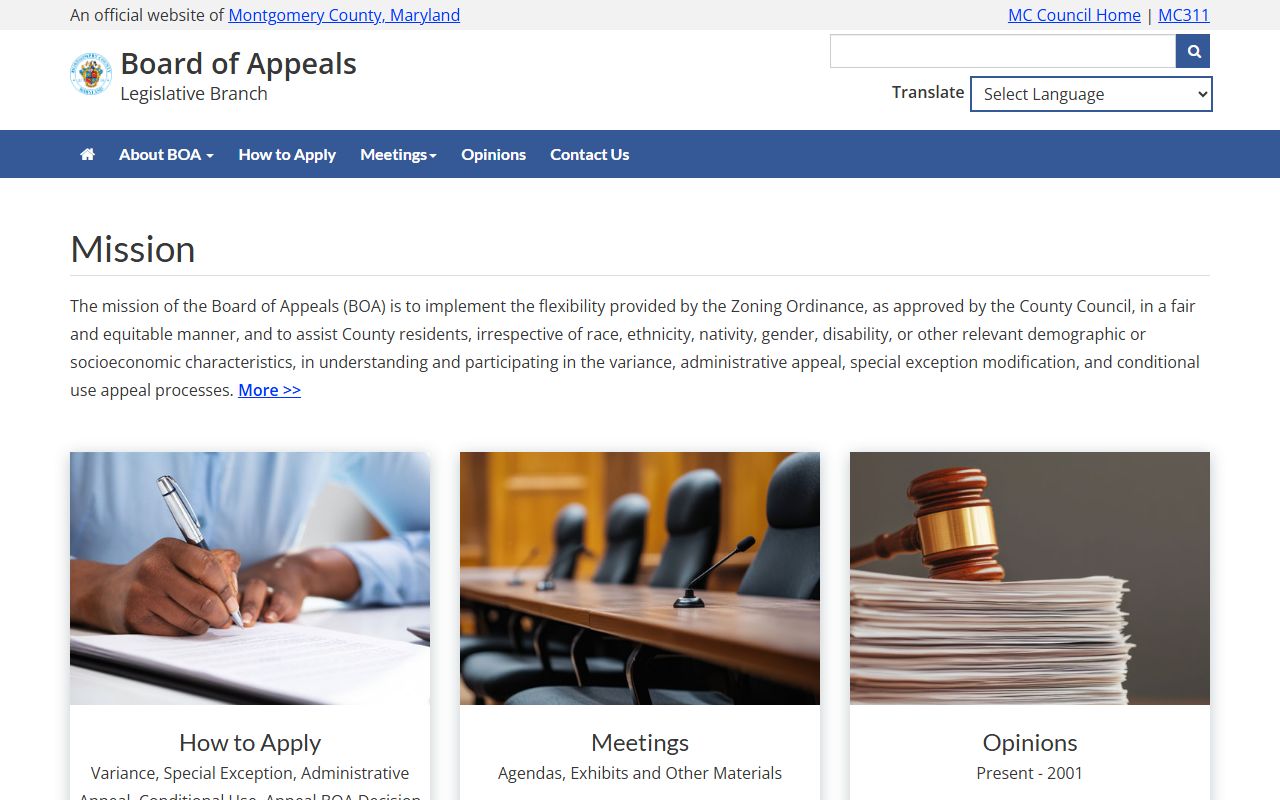
BOA decisions are public records. You can search the Board's online docket to find past rulings on a specific address. This can be helpful when researching property tax records for a parcel with a long or complex use history in Montgomery County.
Maryland Land Records for Montgomery County
Deeds, mortgages, and liens for Montgomery County properties are recorded in the land records system maintained by the Maryland Judiciary. You can search these records at mdlandrec.net. The database covers documents recorded in Montgomery County going back many years. Title researchers, attorneys, and buyers use land records to trace ownership chains, find encumbrances, and verify that a property is free of unpaid liens.
Land records tie closely to property tax records in Montgomery County. A deed transfer triggers a new assessment notice from SDAT. A mortgage lien appears in the land records and may affect how a lender handles tax escrow payments. If a tax lien is recorded against a property, it also shows up in the land records system. Searching both SDAT and land records together gives you the most complete picture of a property's status in Montgomery County.
Under Real Property Article § 3-601, recording fees in Maryland are set by statute. A release costs $10, and a standard document under nine pages costs $20. Documents of ten or more pages cost $75. Certified copies of recorded documents carry a fee set under Real Property Article § 3-602, which is $5 per copy. Lenders operating in Maryland must follow Real Property Article § 7-107, which requires mortgage releases to be recorded within 45 days of payoff. If you have questions about land records, the helpdesk line is (410) 260-6487.
Montgomery County Property Assessment Process
SDAT assesses every property in Montgomery County on a three-year cycle under Tax-Property Article § 2-203. That means each parcel is formally reviewed once every three years. In the years between reviews, the assessed value stays the same unless there is a reason to change it, such as a major addition or a subdivision. The three-year cycle keeps the workload manageable for assessors while still keeping values reasonably current.
Assessors in Maryland use three standard methods depending on the type of property. The sales comparison approach looks at what similar properties sold for near the subject parcel. The cost approach estimates what it would cost to rebuild the structure from scratch, minus depreciation for age and condition. The income approach applies to rental and commercial properties and estimates value based on what the property earns. All three methods are used in Montgomery County, though which one the assessor relies on most depends on the property type.
When your assessment changes, SDAT mails a notice. You have the right to appeal that new value. The first step is an informal hearing with the Supervisor of Assessments at the local SDAT office in Rockville. If that does not resolve the dispute, you can appeal to the Montgomery County Property Tax Assessment Appeals Board. A further appeal goes to the Maryland Tax Court. Under Tax-Property Article § 8-401, a property owner can appeal a final order of the Tax Court to the circuit court if needed. Montgomery County property owners use this process regularly given the high property values in the area.
Tax Credits and Exemptions in Montgomery County
Several tax credit programs are available for Montgomery County property owners. The Homestead Tax Credit limits how much your taxable assessment can rise in a given year, even if the full assessed value goes up significantly. This protects long-term homeowners from sharp tax increases in a rising market. You apply once and the credit stays in place as long as you live in the home as your primary residence. SDAT administers this program statewide, including for Montgomery County.
The Homeowners' Tax Credit is an income-based program. It reduces the property tax bill for lower-income homeowners who meet income and net worth thresholds. Eligibility is not tied to age. Anyone who owns and occupies their home in Montgomery County can apply if their income qualifies. The credit is calculated to limit the tax burden relative to household income. SDAT reviews applications each year and notifies the county of approved credits before tax bills go out.
Disabled veterans may qualify for a full property tax exemption in Maryland. The exemption applies to the primary residence of a qualifying veteran or surviving spouse. Montgomery County also has local credit programs that go beyond what the state offers. The county can grant additional credits for certain property types and circumstances. Contact the Montgomery County Department of Finance or check the county portal at montgomerycountymd.gov for the current list of local programs. The Maryland Historical Trust also administers a tax credit for owners of certified historic structures, which can apply to qualifying properties in Montgomery County's older neighborhoods.
Note: Credit applications have annual deadlines. Missing the filing window means waiting another full year before a credit can take effect on your Montgomery County property tax bill.
Montgomery County Property Tax Payment Information
Montgomery County sends annual property tax bills with two key due dates. The full year's tax is due September 30. If you choose to pay in two installments, the second half is due December 31. Most homeowners with a mortgage have taxes paid through an escrow account held by their lender, which means the lender collects a portion of the annual tax with each mortgage payment and sends payment to the county on their behalf.
For property owners paying directly, the county accepts online payments through the county portal, payments by mail, and in-person payments at county offices in Rockville. Late payments accrue interest at 1 to 1.5 percent per month. If taxes remain unpaid long enough, the county can place the property in a tax sale. At a tax sale, the county sells a tax lien certificate on the property to a third party who pays the owed taxes. The original owner then owes that third party, plus additional costs. Avoiding tax sale is a strong reason to keep up with bills and check payment status through the county's online tools.
Current tax rates for Montgomery County are published at the Maryland Department of Budget and Management tax rates page. Rates are set each year and apply to the taxable assessment, which may differ from the full SDAT assessed value if credits or phase-in limits apply to your parcel. Statute links and code sections for Maryland property tax law can be found through the Maryland General Assembly website and through the Tax-Property Article code reference.
Cities in Montgomery County
Montgomery County includes many large communities, several of which have their own property tax record pages. Property records for all of these cities are assessed by SDAT under county code 16 and are searchable through the same Montgomery County tools described above.
Nearby Counties
Montgomery County borders several Maryland counties. If you are researching a property near a county line, you may want to check neighboring county records as well. Each county uses a different SDAT code and may have its own local tax programs.