
Baltimore City Property Tax Records
Baltimore City property tax records are managed by the State Department of Assessments and Taxation, or SDAT, and the Baltimore City government. Baltimore is an independent city, not part of any county, which gives it a unique place in Maryland's property tax system. If you need to search Baltimore property tax records, look up an assessment, or find out what a property owner owes, this page walks you through the tools and offices that can help.
Baltimore City Overview
SDAT Search for Baltimore City Properties
The primary tool for searching Baltimore property tax records online is the SDAT Real Property Data Search. Baltimore City is listed under county code 03 in the SDAT system. When you open the search portal, select "Baltimore City" from the county dropdown. The system pulls up assessment values, tax billing info, ownership history, and the legal description of the property. It is free to use and open to anyone.
Baltimore uses a unique account number format that differs from all Maryland counties. Every property in Baltimore City is identified by Ward, Section, Block, and Lot. That four-part code is how the SDAT system tracks every parcel in the city. If you know the Ward and Block of a property, you can search directly by account number. If not, you can search by owner name or street address. Both methods work in the SDAT portal. The system returns current ownership, assessed value, and any homestead or exemption status on record for that Baltimore property.
The SDAT office in Baltimore handles all city property assessments. You can reach SDAT by phone at 410-767-1184. Their main site at dat.maryland.gov has forms, appeals info, and contact details for the local Baltimore City office.
The SDAT Real Property Data Search portal at sdat.dat.maryland.gov is the starting point for most Baltimore property tax record searches. The portal shown below lets you select Baltimore City by code and run a search by address, owner name, or account number.
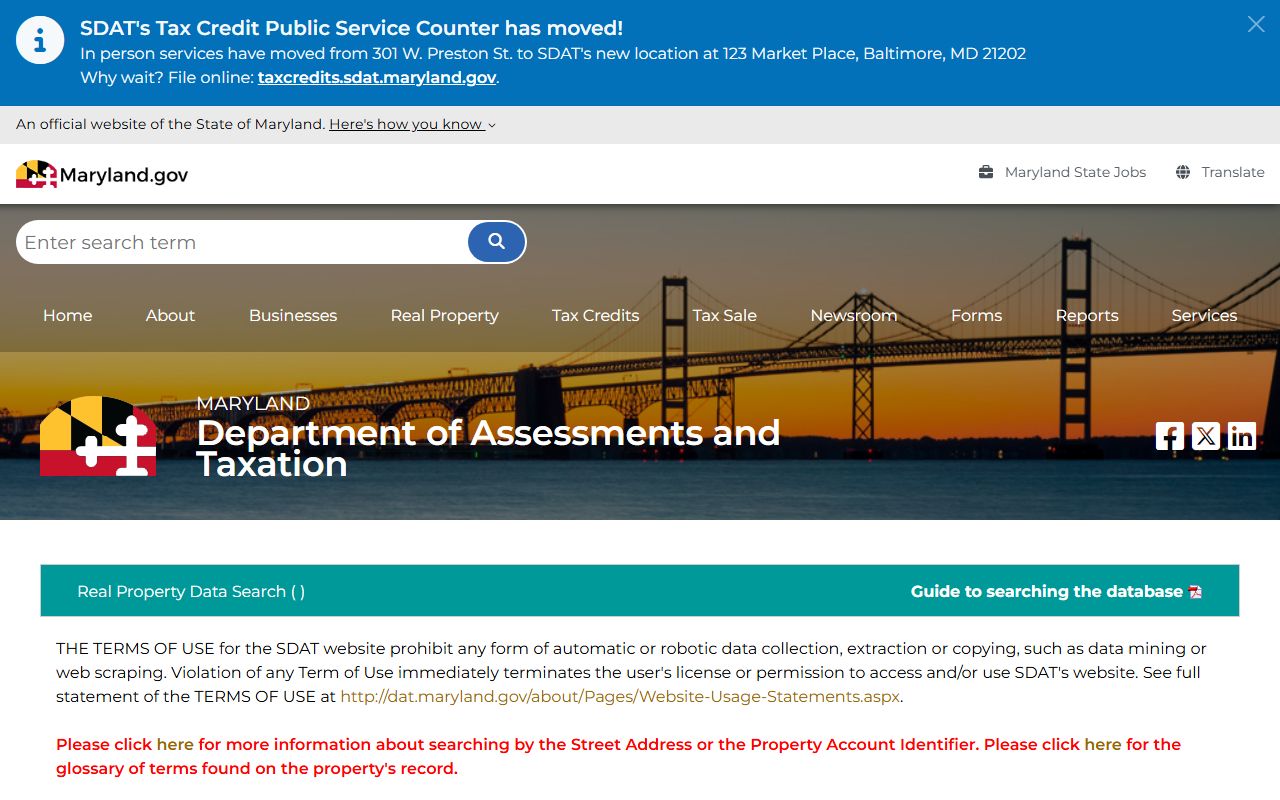
Once you find a property in the portal, you can see its full assessment history, current market value, and any pending appeals. This data is updated regularly and reflects the most recent SDAT cycle for Baltimore City.
Note: Baltimore City properties assessed before the current three-year cycle may show prior values until SDAT completes its next reassessment round under Tax-Property Article § 2-203.
Baltimore City Government Property Tax Resources
The Baltimore City government website has a dedicated section for property taxes and payments. This is where you go to pay your tax bill, set up automatic payments, or check your account balance. The city bills property taxes annually, with the first installment due by September 30 and the second due by December 31 each year.
Baltimore City's property tax rate is set each year as part of the city budget. The rate applies to the assessed value SDAT assigns to each property. Because Baltimore is an independent city, it collects both city and what would otherwise be county taxes, meaning the combined rate is higher than what most Maryland counties charge. Property owners in Baltimore pay one combined bill that covers both city and state obligations.
The city offers a 311 service for property-related issues. If you have questions about your tax bill, a billing error, or a problem with a vacant property near you, calling 311 connects you to the right city department. Many routine tax questions can be resolved that way without visiting a city office. The Baltimore City government website also lets you look up whether a specific property has outstanding tax debt, which is useful when researching a property before buying.
The Baltimore City government website shown below gives access to property tax payment tools, account lookups, and department contacts for city property owners.
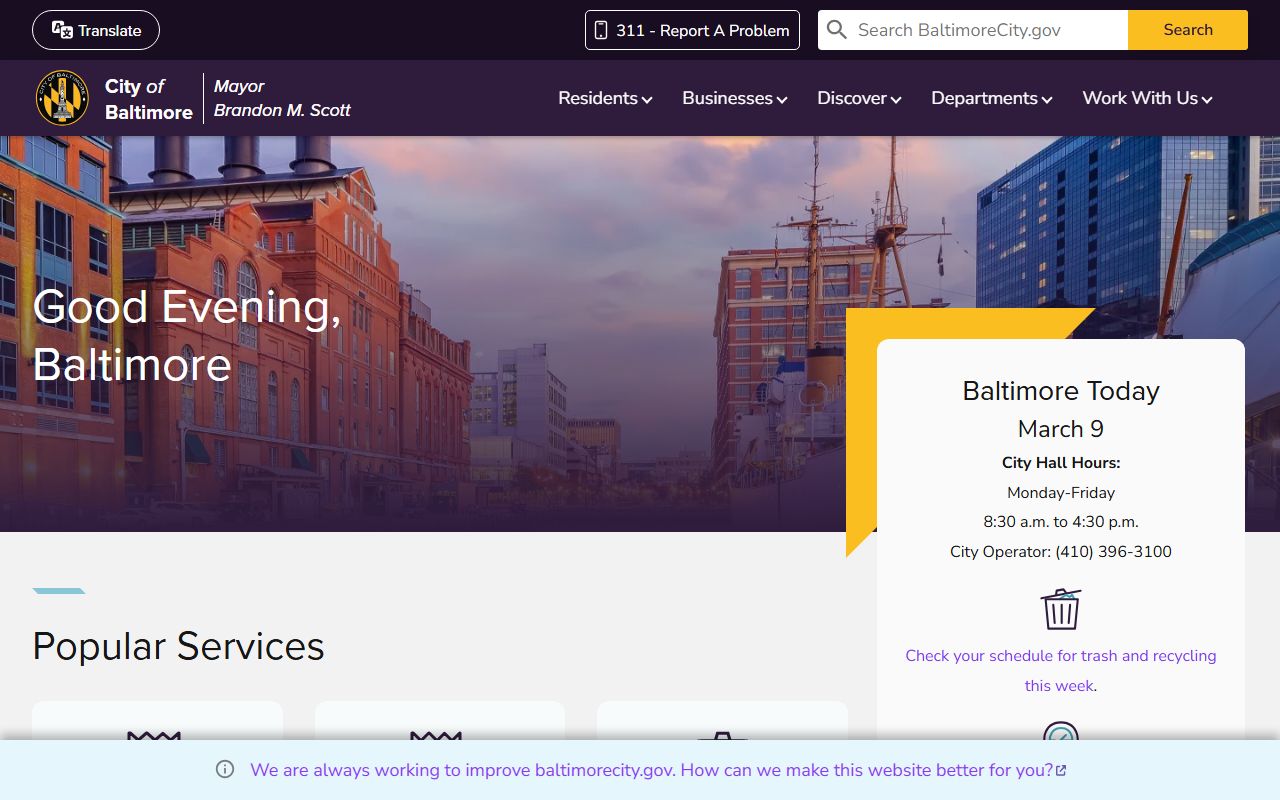
From the city site you can also find links to the Finance Department, which manages tax billing, and the Department of Housing and Community Development, which tracks vacant and abandoned properties across Baltimore.
Baltimore City Property Tax Payment Plans
Baltimore City offers payment plan options for property owners who fall behind on their taxes. These plans let eligible owners pay down delinquent balances over time instead of facing immediate tax sale. The city opens applications for these programs on a set schedule. If you want to sign up, you need to watch for alerts since application windows are limited.
Interest on delinquent Baltimore City property taxes runs at 1 to 1.5 percent per month. That adds up fast if a balance goes unpaid for several months. Getting into a payment plan stops additional penalties from growing while you work down the debt. The city has used these plans to help property owners who have equity in their homes but cannot pay a large lump sum. You apply through the Baltimore City Finance Department. The city's website at baltimorecity.gov lists the current status of payment plan applications and instructions for signing up when the window opens.
If a property tax bill in Baltimore City goes unpaid long enough, the city can place that property in the annual tax sale. Real Property Article § 3-104 is clear that taxes must be paid before a deed can be recorded on a property, so tax debt follows ownership. Avoiding tax sale means staying current or getting into a plan before the sale date each year.
Note: Tax sale in Baltimore City typically happens in May, so property owners with delinquent bills should act well before spring to protect their properties.
Reframe Baltimore and Property Assessments
Reframe Baltimore is the city's 15-year initiative to eliminate vacant and abandoned properties. Baltimore has thousands of vacant structures, and this program aims to bring them back into productive use or demolish them. The effort has direct effects on property tax records because vacants are assessed differently, may carry liens, and can change quickly in status as the program moves forward.
If you are researching a Baltimore property near a vacant structure or in a target neighborhood, check both the SDAT record and the city's housing department data. A property that looks cheap on paper may carry back taxes or city liens tied to the vacant next door. The Reframe Baltimore program can also affect assessed values in neighborhoods where large numbers of vacants are being cleared, since comparables change when blighted properties are removed from the market.
For property owners in Baltimore whose land values shift because of Reframe Baltimore activity, the standard assessment appeal process applies. You have the right to appeal to the Supervisor of Assessments at the Baltimore City SDAT office, then to the Baltimore City Board, and finally to the Maryland Tax Court at courts.state.md.us/mdtaxcourt if needed. Tax-Property Article § 8-401 sets the framework for how assessments are challenged in Maryland.
Maryland Land Records for Baltimore City
Property tax records in Baltimore tell you what a property is worth and what is owed. Land records tell you who owns it and what encumbrances exist. Both sources together give you the full picture. For Baltimore City land records, the main portal is Maryland Land Records at mdlandrec.net. You can search deeds, mortgages, liens, and other documents recorded against Baltimore City properties going back many years.
When a Baltimore property changes hands, the deed must be recorded in the land records. Under Real Property Article § 3-104, taxes must be paid and cleared before a deed is recorded. That rule links the tax records and land records together. If you pull up a deed in the land records and see a gap in ownership, there may be a tax issue in the property's history worth investigating.
Recording fees for land documents in Baltimore City are set under Real Property Article § 3-601. The fee is $10 to record a release, $20 for documents up to nine pages, and $75 for documents of ten pages or more. Certified copies of recorded documents cost $5 per document under Real Property Article § 3-602. Lenders must release paid mortgages within 45 days of payoff under Real Property Article § 7-107, so if you are checking a Baltimore property and see an old mortgage in the records, it may simply be a delayed release.
The Maryland State Archives at msa.maryland.gov holds older historical land records for Baltimore City that predate the current digital systems. For title research going back a century or more, the Archives is a useful secondary source.
Baltimore City Property Assessment Process
SDAT reassesses all Baltimore City properties on a three-year cycle under Tax-Property Article § 2-203. Each year, roughly one-third of Baltimore properties get a new assessment notice. When your property is reassessed, SDAT looks at three approaches: the sales comparison method, the cost approach, and the income approach. For residential properties in Baltimore, the sales comparison method usually carries the most weight.
When you get a new assessment notice, you have 45 days to appeal to the Supervisor of Assessments at the Baltimore City SDAT office. If you are not happy with that result, you can go to the Baltimore City Board of Property Tax Appeals. The final step is the Maryland Tax Court. Most Baltimore homeowners who appeal do so at the Supervisor level because it is free and informal. Bring recent sales data for comparable homes in your neighborhood and any evidence that SDAT used the wrong comparables.
The Homestead Tax Credit is one of the most important tools for Baltimore City homeowners. It limits how much your taxable assessment can rise each year, even if the market value jumps sharply. In Baltimore City, the Homestead cap is set by local ordinance and applies to your principal residence. Once you register for the Homestead Credit, the cap stays in place as long as you live there and continue to qualify. You register once through SDAT, and then the protection renews automatically each year.
You can check current and historical tax rates for Baltimore City through the Department of Budget and Management at dbm.maryland.gov. Rates change with each city budget cycle, so it helps to verify the current year rate when you are calculating what a property owes.
Note: A property that changes ownership in Baltimore City may lose its Homestead Credit, since the credit applies to the owner-occupant, not the property itself.
Baltimore City Tax Credits and Exemptions
Several tax credit programs can reduce what Baltimore property owners owe. Some are state programs that apply across Maryland, while others are local credits set by Baltimore City. Knowing which credits you qualify for can make a real difference in your annual tax bill.
The Homeowners' Tax Credit is a state program based on income. If your property taxes are high relative to your income, the state will refund part of the difference. This credit is available to both owners and renters in Maryland, but property owners in Baltimore apply through SDAT. The Maryland General Assembly sets the rules, and you can find the current statute language at mgaleg.maryland.gov. Applications are due by September 1 each year for the prior tax year's bill.
Disabled veterans who own property in Baltimore City may qualify for a full or partial exemption from property taxes. The exemption amount depends on the veteran's disability rating. Surviving spouses of disabled veterans may also qualify. You apply through the Baltimore City SDAT office at 410-767-1184 and need to provide proof of disability rating from the VA.
The following credits may apply to Baltimore City property owners:
- Homestead Tax Credit (caps assessment increases for owner-occupants)
- Homeowners' Tax Credit (state income-based refund program)
- Disabled Veterans' Exemption (full or partial based on rating)
- Historic Preservation Tax Credit (for qualifying renovations)
- Baltimore City local supplement credits (set by city ordinance)
Baltimore City also runs additional local credit programs that go beyond the state minimum. These include credits for seniors, credits tied to neighborhood revitalization zones, and energy efficiency incentives. Check the Baltimore City Finance Department's website for the current list of available local credits. The Maryland Open Data Portal at opendata.maryland.gov has statewide credit participation data if you want to see how many city property owners use each program.
Note: You must apply for most tax credits separately; they do not apply automatically when you buy a home in Baltimore City.
Nearby Cities
Baltimore City is surrounded by Baltimore County and Anne Arundel County. Several nearby communities have their own property tax records pages. These cities and census-designated places are served by county-level SDAT offices and county tax collection systems, which differ from Baltimore City's independent structure.