
Dundalk Property Tax Records
Dundalk property tax records are held by Baltimore County, which handles all assessments, billing, and collection for this unincorporated community. Whether you need to look up a current assessment, check what taxes are owed on a parcel, or find out how to appeal a value, Baltimore County and the State Department of Assessments and Taxation are your two main sources. This page covers the key tools and offices that serve Dundalk property owners and researchers.
Dundalk Quick Facts
Baltimore County Property Tax System for Dundalk
Dundalk is an unincorporated community, which means it has no city government of its own. Baltimore County handles everything from assessments to tax billing. Property owners in Dundalk receive bills from Baltimore County and pay taxes to the county, not a separate municipality. That makes Baltimore County the central hub for all Dundalk property tax records.
The Baltimore County government website has an online property tax portal where you can look up current bills, past payments, and account balances for any parcel in the county, including those in Dundalk. You can search by street address or account number. The site also shows whether a property has any unpaid balances or tax sale flags. This is useful if you are researching a Dundalk property before a purchase or checking your own account to confirm payments went through.
Baltimore County bills property taxes once per year. The tax year runs July 1 through June 30. Bills go out in the summer, and the due date is typically July 1, with interest starting on October 1 for bills not paid in full. Property owners who miss the due date accrue monthly interest on the unpaid balance. If you are not sure whether your Dundalk tax bill is current, the Baltimore County online portal will show the balance as of the date you check.
The Baltimore County Office of Budget and Finance manages tax collection. Their mailing address is 400 Washington Avenue, Towson, MD 21204. You can call their office at 410-887-2404 for questions about your Dundalk property tax bill, payment options, or account status. In-person help is also available at the Towson office on weekdays during normal business hours.
Baltimore County also publishes an annual tax rate through the Department of Budget and Management. You can check current and prior year rates at dbm.maryland.gov. Knowing the current rate helps you calculate what a Dundalk property should owe based on its assessed value.
SDAT Search for Dundalk Property Records
The Maryland State Department of Assessments and Taxation, or SDAT, is the state agency that assesses all real property in Maryland. For Dundalk properties, you use county code 04 in the SDAT Real Property Data Search. This free tool lets you search by address, owner name, or account number. Results include the current assessed value, ownership name, property description, and homestead or exemption status.
The SDAT portal at sdat.dat.maryland.gov is the quickest way to pull up a Dundalk property record without making any calls or visiting an office. Once you select Baltimore County from the dropdown and enter a Dundalk address, the system returns the full record for that parcel. You can see when the property was last assessed, what the land and improvement values are, and whether any credits or exemptions are applied. The data in SDAT reflects the most recent reassessment cycle under Tax-Property Article § 2-203.
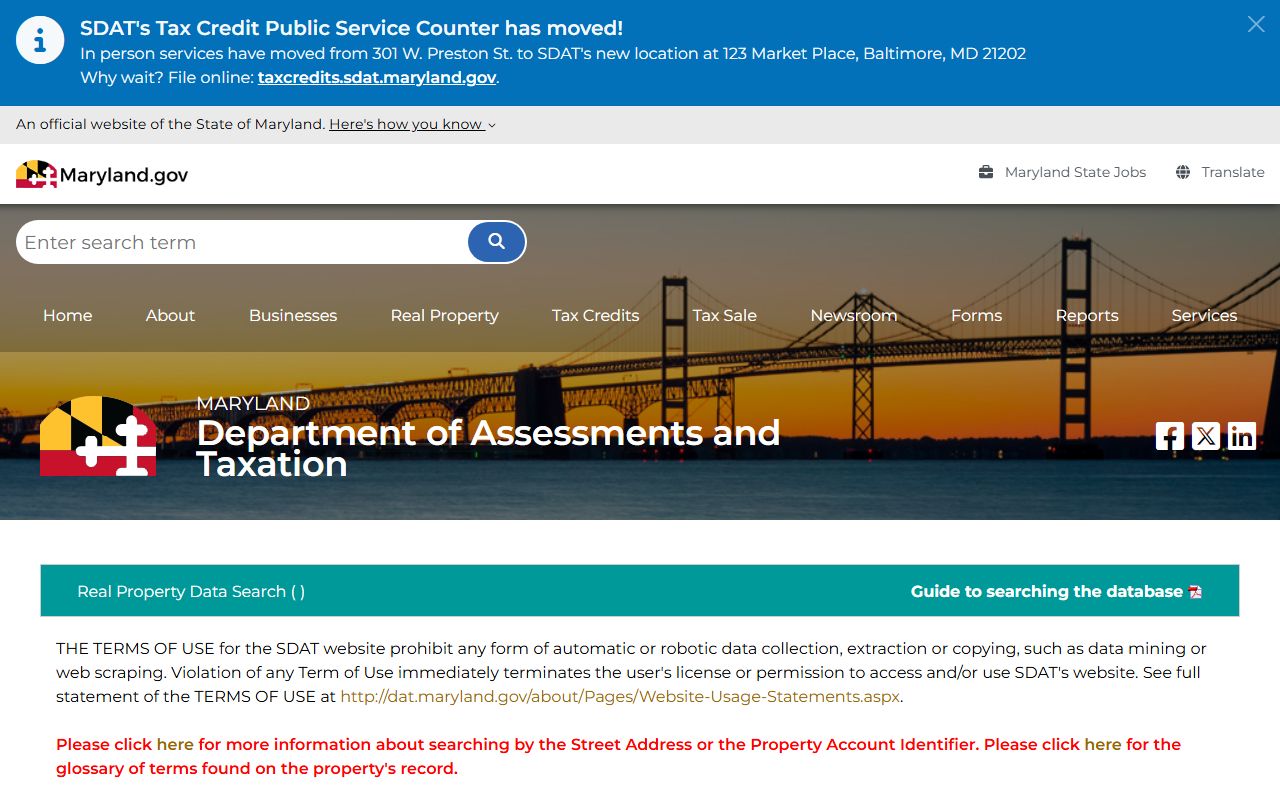
SDAT also keeps a record of prior assessment cycles, so you can see how a Dundalk property's value has changed over time. That history is useful when preparing an appeal or doing research on a property's market trajectory. The main SDAT site at dat.maryland.gov has contact information for the Baltimore County SDAT office, forms for credits and exemptions, and guidance on the appeal process.
If you need to speak with someone at SDAT about a Dundalk property, the Baltimore County SDAT office is in Towson at 401 Bosley Avenue, Suite 101. Their phone number is 410-512-4900. Staff can help you understand your assessment notice, confirm whether a credit is on file, or guide you through what to bring for an appeal hearing.
Baltimore County Online Property Tax Portal
Baltimore County's online property tax portal is separate from SDAT and focuses on billing rather than assessed values. While SDAT shows you what a property is worth and how it was assessed, the county portal shows you what is owed and what has been paid. Both tools are useful, and most people doing Dundalk property research will want to check both.
To use the county portal, go to the Baltimore County government site at baltimorecountymd.gov and navigate to the tax search section under the Finance Department. You can search by property address or by account number. The portal returns the current balance, any prior year amounts due, and a payment history going back several years. If you are buying a Dundalk property, pulling this portal record lets you confirm the seller is current on taxes before closing.
The county portal also shows whether a Dundalk property has been flagged for tax sale. Tax sale in Maryland is the process by which the county sells tax liens to investors when a property owner falls too far behind. Once a tax sale certificate is sold, the property owner has a redemption period to pay off the lien before the investor can move toward foreclosure. Catching this early through the portal is far better than finding out at closing.
Baltimore County also operates a MyNeighborhood GIS tool that shows property data on an interactive map. You can view parcel boundaries, ownership, and tax information overlaid on a street map of Dundalk. This is a good tool if you know a general area but not a specific address. The GIS map lets you click on a parcel and get basic assessment and ownership data right on the map screen.
Assessment Process for Dundalk Properties
Maryland reassesses all properties on a three-year cycle under Tax-Property Article § 2-203. Dundalk properties are in Baltimore County's rotation, so about one-third of Dundalk parcels get a new assessment notice each year. When SDAT reassesses a Dundalk property, an assessor looks at the property's value using the sales comparison approach, the cost approach, and sometimes the income approach for investment properties. For most single-family homes in Dundalk, recent sales of similar homes in the area carry the most weight.
When SDAT sends a new assessment notice, you have 45 days from the notice date to file an appeal. That deadline is firm. If you miss the 45-day window, you lose the right to challenge that assessment until the next reassessment cycle. When you get a notice for your Dundalk property, check the value against recent sales in your neighborhood. If similar homes sold for less than what SDAT is saying your property is worth, that is your evidence for an appeal. You can find recent sales data through the Maryland Land Records site or through local real estate listing services.
The assessment notice for a Dundalk property also shows your phased-in value, which is the value used for tax billing in each year of the three-year cycle. Maryland phases in assessment increases over three years so that a large jump in value does not hit you all at once. The notice will show the current year value, the phased-in billing amount, and projections for the next two years of the cycle. Understanding the phase-in is important when you are trying to predict what your Dundalk tax bill will look like in the coming years.
SDAT uses several types of data to set Dundalk values, including permit records, aerial imagery, and field inspections. If SDAT made a factual error, such as listing the wrong number of bedrooms or an incorrect lot size, you can raise that as part of your appeal. Factual corrections sometimes result in value reductions without needing to argue market comparables at all.
Tax Credits for Dundalk Property Owners
Several Maryland tax credit programs can lower what Dundalk property owners owe each year. Some apply automatically once you register, while others require an annual application. Knowing which ones you qualify for is worth checking before each tax year.
The Homestead Tax Credit is the most widely used credit for Dundalk homeowners. It caps how much your taxable assessment can increase from one year to the next, even if your market value rises sharply. For Baltimore County, the Homestead cap limits the annual taxable value increase to 4 percent. Once you register with SDAT, the cap stays in place as long as the property is your principal residence. You only register once, and the credit renews automatically. If you bought a Dundalk home and never registered, you may be missing this protection. Check your status at dat.maryland.gov or call the Baltimore County SDAT office at 410-512-4900.
The Homeowners' Tax Credit is a state income-based program that refunds part of your property tax bill if taxes are high relative to your income. This program is run by SDAT. Applications are due by September 1 each year for the prior tax year's bill. You can find forms and income guidelines at dat.maryland.gov. Many Dundalk property owners qualify but never apply because they do not know the program exists.
Disabled veterans who own property in Dundalk may qualify for a full or partial exemption. The exemption amount depends on the disability rating from the VA. Surviving spouses of qualifying veterans may also be eligible. You apply through the Baltimore County SDAT office and need to bring your VA disability letter. The exemption can significantly cut your annual bill if you qualify at the higher rating levels.
Available credits for Dundalk property owners include:
- Homestead Tax Credit (caps annual taxable value increases for owner-occupants)
- Homeowners' Tax Credit (state income-based refund for eligible owners)
- Disabled Veterans' Exemption (full or partial depending on VA rating)
- Senior Tax Credit (available to qualifying Baltimore County seniors)
- Historic Preservation Credit (for eligible renovation projects)
The Maryland General Assembly sets the rules for state-level credit programs. You can review current statute language for these programs at mgaleg.maryland.gov. Baltimore County may also offer local supplement credits beyond the state minimum, so checking the county Finance Department site for any Dundalk-specific programs is worth a few minutes of your time.
Maryland Land Records for Dundalk
Property tax records tell you about assessed value and what is owed to Baltimore County. Land records tell you about ownership and liens. For a full picture of any Dundalk property, you want to check both. The Maryland Land Records portal at mdlandrec.net is where deeds, mortgages, liens, and other documents recorded against Dundalk properties are stored and searchable.
When a Dundalk property is sold, the deed gets recorded in the Baltimore County land records through the circuit court clerk. Under Real Property Article § 3-104, taxes must be paid and cleared before a deed can be recorded. That rule connects the tax record to the land record. If you pull a deed for a Dundalk property and the prior owner had unpaid taxes, those taxes would have had to be settled before the deed could go through. That is one reason why checking land records and tax records together gives you a cleaner picture of a property's history.

The Land Records portal lets you search by grantor name, grantee name, or property address. You can pull up deeds, mortgage releases, lien filings, and other instruments. Older documents may be scanned images, while more recent ones are often text-searchable. If you are doing title research on a Dundalk property, this is the starting point for tracing the chain of ownership.
For very old Dundalk land records predating the digital system, the Maryland State Archives holds historical documents. Their site at baltimorerecords.us can also help you find property-related records for Baltimore County. These sources are most useful for research going back several decades or more.
Appealing a Dundalk Property Assessment
If you think SDAT has overvalued your Dundalk property, you have the right to appeal under Tax-Property Article § 8-401. The process has three levels: first to the Supervisor of Assessments at the Baltimore County SDAT office, then to the Baltimore County Board of Property Tax Appeals, and finally to the Maryland Tax Court. Most Dundalk homeowners who appeal do so at the first level, which is free, informal, and does not require a lawyer.
To file a first-level appeal for your Dundalk property, you need to submit a written request to the Baltimore County SDAT office within 45 days of your assessment notice. You will get a hearing date, usually within a few months of filing. At the hearing, bring your evidence. Good evidence includes recent sales of comparable Dundalk homes with lower values, a recent appraisal of your property, or documentation of a factual error in the SDAT record such as wrong square footage or incorrect property features. The assessor will present the county's case, and you will have a chance to respond.
If the first-level result is not what you wanted, you can appeal to the Baltimore County Board of Property Tax Appeals. That step is still free, but slightly more formal. You present evidence, the county presents its case, and the board makes a decision. If you still disagree after the board rules, you can take the case to the Maryland Tax Court at courts.state.md.us/mdtaxcourt. The Tax Court level is a formal legal proceeding, and some Dundalk property owners choose to use an attorney or a licensed property tax consultant at that stage.
Appeals for Dundalk properties do not stop your tax bill. You still owe the tax based on the disputed value while the appeal is pending. If you win and the value comes down, Baltimore County will issue a credit or refund for the difference. Keep that in mind when planning your cash flow during the appeal period.
One tip: look at what SDAT used as comparable sales before your hearing. You can request that information from the Baltimore County SDAT office ahead of time. Knowing which sales they relied on lets you challenge specific comparables or show that more relevant sales were overlooked. That kind of targeted argument tends to work better than a general claim that the value feels too high.
Nearby Cities
Dundalk sits in eastern Baltimore County, near Baltimore City and several other major communities in the region. The following cities have property tax records pages with local courthouse and assessment details.