
Talbot County Property Tax Records
Talbot County property tax records are managed through the Maryland State Department of Assessments and Taxation, which sets values for all real property on the Eastern Shore. Whether you need to look up a current assessment, check a tax bill, or find deed and lien records tied to a parcel in Talbot County, this page walks you through the main sources and how to use each one. Records are available online for most properties, and in-person help is available through county and state offices in Easton.
Talbot County Overview
SDAT Search for Talbot County Property Tax Records
The fastest way to look up Talbot County property tax records is through the SDAT Real Property Data Search at sdat.dat.maryland.gov. This is the state's main public database for assessments, and it covers every parcel in Talbot County. The search is free and open to anyone. You do not need to create an account to use it.
To search Talbot County records in the SDAT system, select "Talbot County" from the county dropdown or enter county code 21. You can search by street address, map reference, or the property owner's name. Each result shows the current assessed value, the property class, the owner of record, and the most recent sale. The map reference number is especially useful for waterfront parcels in Talbot County, where street addresses can sometimes be incomplete or informal. The SDAT main site at dat.maryland.gov also has contact information and guidance if you get stuck. Their main phone line is 410-767-1184.
The screenshot below shows the SDAT real property search portal where you can select Talbot County and pull up individual assessments.
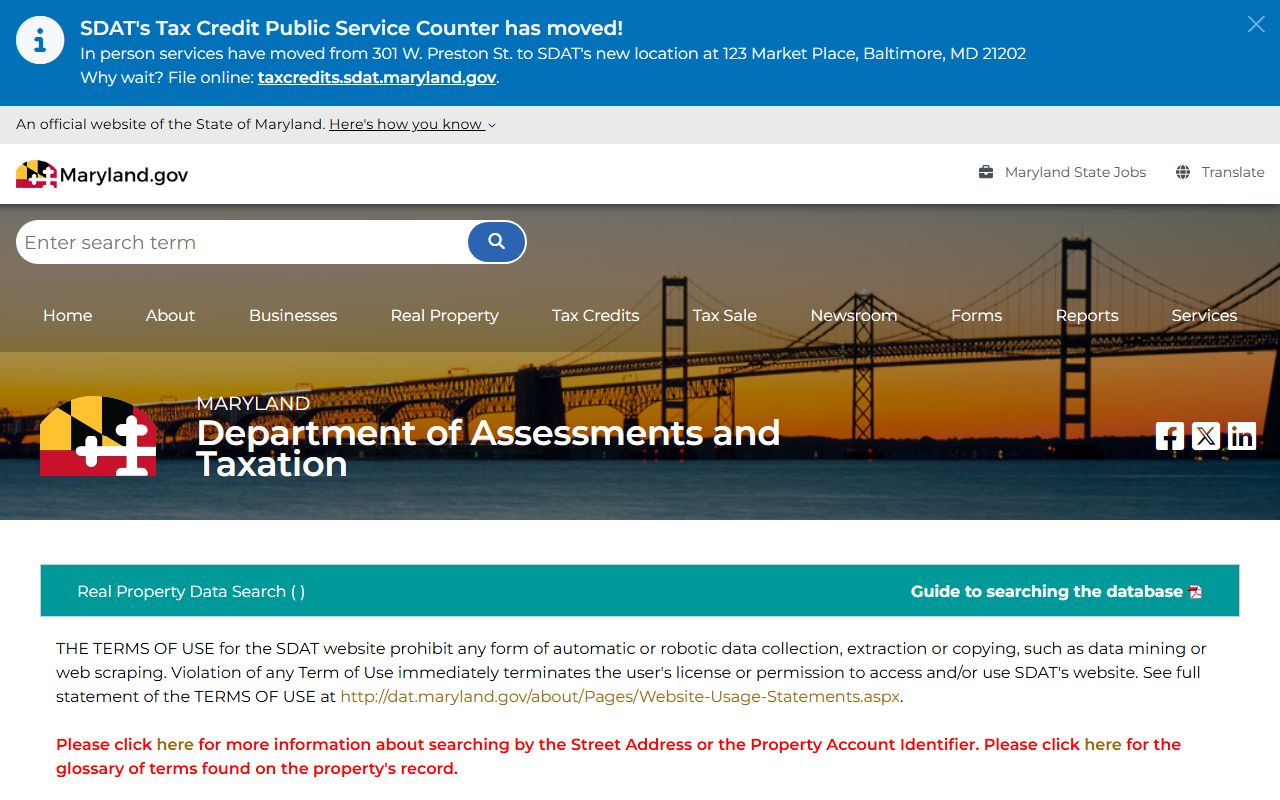
Once you pull up a parcel in Talbot County, the detail page shows the full assessment history, prior ownership, and any supplemental assessments that were issued between the regular three-year cycles. This is useful if a property changed hands or was improved after the last cycle ran.
Note: The SDAT real property database reflects assessed values, not tax bills. For the actual amount owed, contact the Talbot County Finance Office directly.
Talbot County Government Finance and Planning Offices
Two county offices handle most property tax questions in Talbot County. The Finance Office processes tax payments, manages billing, and handles delinquent accounts. The Planning and Zoning office holds property information related to land use, permits, and zoning classifications that can affect assessments. Both are located in Easton.
The Talbot County Government website at talbotcountymd.gov gives access to both offices. For tax payments, the Finance Office is the right contact. Bills go out annually, with the first installment due September 30 and the second due December 31. If you miss a payment, interest begins at 1 to 1.5 percent per month depending on the type of tax. Extended non-payment can lead to tax sale proceedings in Talbot County. The Finance Office can tell you the exact balance on any parcel, including any accrued interest or penalties.
The screenshot below is from the Talbot County Government website, which links to both the Finance Office and Planning and Zoning departments.
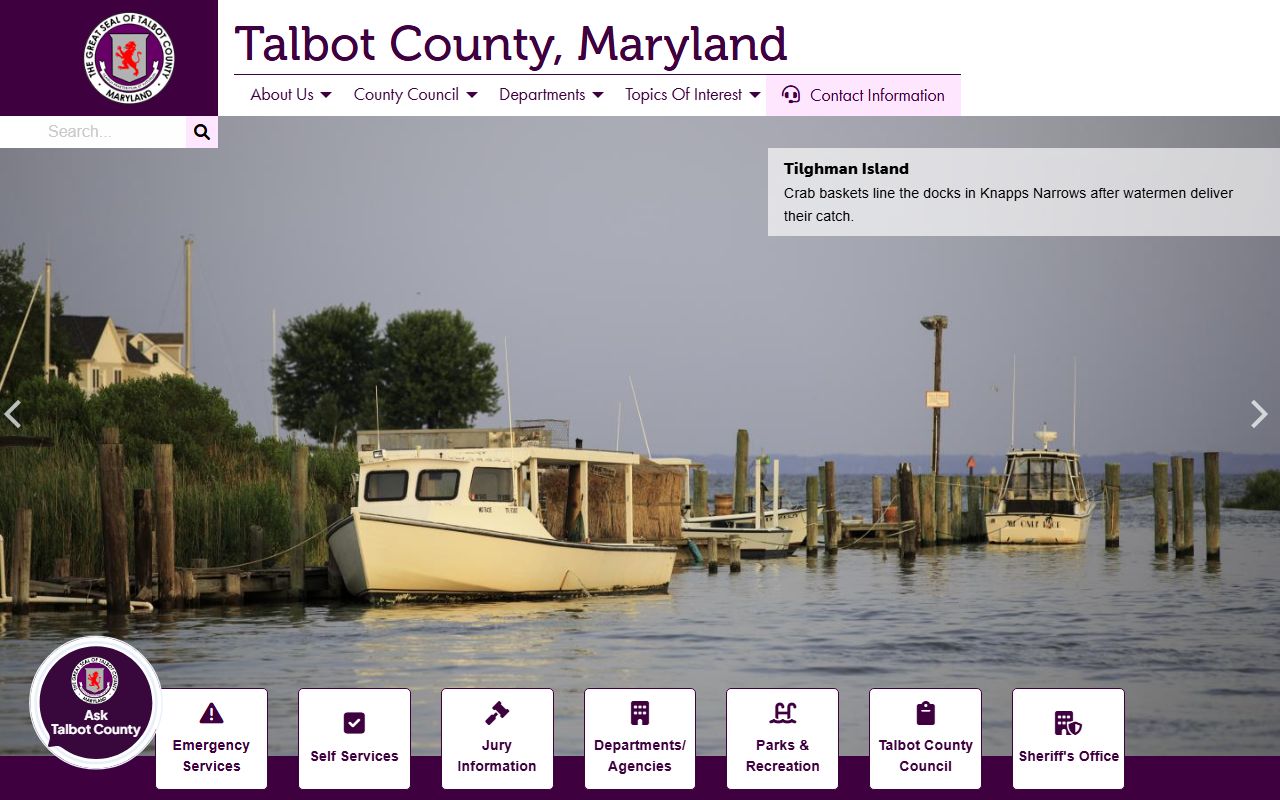
Planning and Zoning in Talbot County maintains records on lot sizes, zoning districts, critical area designations, and subdivision plats. These records matter for buyers and owners of waterfront land along the Chesapeake Bay and its tributaries, where development restrictions can directly affect value. Planning records are not the same as SDAT assessments, but the two often need to be read together to fully understand a property's status in Talbot County.
| County Seat | Easton, Maryland |
|---|---|
| Finance Office | Talbot County Government, Easton, MD |
| Website | talbotcountymd.gov |
| Tax Bill Due Dates | September 30 (first) and December 31 (second) |
Waterfront Property Assessments in Talbot County
Talbot County has over 600 miles of shoreline along the Chesapeake Bay and its tidal tributaries. That makes waterfront property a major part of the local tax base. Assessing these parcels is more involved than assessing a standard residential lot, and the methods SDAT uses in Talbot County reflect that complexity.
For waterfront and vacation rental properties in Talbot County, SDAT assessors rely heavily on the income approach alongside the standard sales comparison and cost approaches. Under the income approach, the property's potential rental income is analyzed to estimate its value. This is especially relevant for houses on the Miles River, the Tred Avon River, and the Eastern Bay, where many owners rent through short-term platforms. Assessors look at rental data, occupancy rates, and comparable income-producing properties when setting values on these types of parcels in Talbot County. The result is that two waterfront houses that look similar on paper can carry very different assessed values depending on how each is used and what income it generates.
The sales comparison approach still forms the backbone of most assessments in Talbot County. SDAT looks at recent arm's-length sales of similar properties and adjusts for differences in size, location, water frontage, and condition. In areas like Oxford and St. Michaels, where demand for waterfront lots has been strong, sale prices have pushed assessed values up over successive three-year cycles. Owners who believe their assessment is out of line with actual sales data have a clear path to challenge it.
Note: Properties in Talbot County's Critical Area overlay near the Chesapeake Bay shoreline may carry special designations that SDAT reflects in the property record detail page.
Maryland Land Records for Talbot County
Property tax records in Talbot County are closely tied to land records held at the Circuit Court. Deeds, mortgages, liens, and releases are all recorded there and indexed in the statewide Maryland Land Records system at mdlandrec.net. You can search Talbot County land records by grantor, grantee, or parcel reference without visiting the courthouse.
Understanding the link between deed records and tax records matters in Talbot County. Under Real Property Article § 3-104, all property taxes must be paid in full before a deed can be recorded. This means that when a Talbot County property sells, any outstanding tax balance gets cleared at settlement. It also means that a check of land records can help you confirm whether back taxes were paid when the property last changed hands. That history is part of the public record in Talbot County.
Recording fees in Talbot County follow the statewide schedule under Real Property Article § 3-601: $20 for documents up to nine pages and $75 for ten or more pages. A release or discharge costs $10. Certified copies of recorded documents cost $5 per document under § 3-602. Under Real Property Article § 7-107, lenders have 45 days to record a release after a mortgage is paid off. You can verify this through the land records portal at mdlandrec.net if you are checking whether a lien has been cleared on a Talbot County parcel.
Assessment Process in Talbot County
Maryland reassesses all real property on a three-year cycle. Talbot County properties fall into one of three groups, each reassessed every third year. This schedule is set under Tax-Property Article § 2-203. When your group comes up for reassessment, SDAT reviews the property and mails a Notice of Assessment. You have 45 days from that notice to file an appeal.
Three valuation methods apply to Talbot County property tax assessments: the sales comparison approach, the cost approach, and the income approach. Sales comparison is the most common for residential properties. The cost approach is used when comparable sales are limited, especially for unique or custom-built homes. The income approach applies to rental and commercial property, and as noted above, it plays a larger role in Talbot County than in many other Maryland counties because of the volume of vacation and waterfront rental properties here.
Phased-in assessment increases are a key feature of the Maryland system. If your Talbot County property's assessed value goes up, the increase is phased in equally over three years rather than applied all at once. This helps limit sudden jumps in your tax bill. The phased value is what appears on your bill from the Talbot County Finance Office, not necessarily the full new value. You can see both numbers on the SDAT detail page for your parcel.
Under Tax-Property Article § 8-401, property owners in Maryland can appeal their assessment at three levels: first to the local Supervisor of Assessments in Talbot County, then to the Maryland Property Tax Assessment Appeals Board, and finally to the Maryland Tax Court at courts.state.md.us/mdtaxcourt. Most disputes in Talbot County are resolved at the first or second level.
Tax Credits and Exemptions for Talbot County Property
Several credits can reduce the property tax burden on Talbot County property owners. The most widely used is the Homestead Tax Credit, which caps how much a principal residence's assessed value can increase in any year. Once you establish the credit on your Talbot County home, it stays in place as long as you live there. Applications go through SDAT at dat.maryland.gov.
The Homeowners' Tax Credit is income-based and available to both owners and renters in Talbot County who pay more than a set percentage of their income in property taxes. This credit is administered through SDAT and requires an annual application. It can result in a significant reduction for eligible households, particularly retirees and lower-income owners on fixed incomes. The application deadline is September 1 each year, and you apply through the state rather than the Talbot County government directly.
Disabled veterans who own property in Talbot County may qualify for a full or partial exemption on their principal residence. The exemption amount depends on the veteran's disability rating and is applied to the assessed value before the tax rate runs. Contact SDAT or the Talbot County Finance Office to start the exemption application process.
Talbot County also has notable historic properties in Easton and Oxford that may qualify for credits through the Maryland Historical Trust. Historic tax credits can apply to rehabilitation work on certified historic structures. For Talbot County property owners with older homes, especially those in recognized historic districts in Easton, these credits are worth reviewing alongside the standard assessment system. The Maryland Historical Trust website has program details and eligibility requirements.
Note: Tax credit applications have strict deadlines, and missing them can mean waiting a full year to reapply for benefits that could reduce your Talbot County property tax bill.
Talbot County Property Tax Payment and Delinquency
Talbot County property tax bills go out once a year. The first installment is due September 30. The second is due December 31. Both are billed on the same notice. You can pay through the Talbot County Finance Office by mail, in person, or online through the county's payment portal at talbotcountymd.gov.
If a payment is late, interest accrues at a rate of 1 to 1.5 percent per month on the unpaid balance. Talbot County follows state law on this, and the rate can compound quickly if a bill goes ignored. Properties that fall significantly behind in taxes become eligible for tax sale. Maryland's tax sale process allows the county to sell the tax lien, not the property itself, to a buyer who then collects the debt plus interest from the property owner. If the owner does not redeem the lien within the redemption period, the lienholder may eventually pursue a deed. This is a serious outcome that Talbot County property owners should take steps to avoid by keeping current on payments or communicating with the Finance Office if hardship arises.
Tax rates in Maryland are set each year. You can check the current rate for Talbot County through the Department of Budget and Management rate table at dbm.maryland.gov. The state rate and the Talbot County rate both apply to your assessed value. Some towns within Talbot County, such as Easton, Trappe, Oxford, and Queen Anne, may also levy a municipal property tax on top of the county and state rates.
For a broader look at Maryland property data across Talbot County and other jurisdictions, the Maryland Open Data Portal offers downloadable datasets on property values, assessment rolls, and tax collections that researchers and professionals often find useful.
Nearby Counties
These counties border or are close to Talbot County on Maryland's Eastern Shore. Each has its own SDAT assessment office and county tax billing process. If a property spans a county line or if you need records from an adjacent jurisdiction, these pages have the relevant details.